Blog
Hunting Blinds Iowa | Complete Guide to Deer Blinds, Regulations & Choosing the Right Blind

Hunting Blinds Iowa | Complete Guide to Deer Blinds, Regulations & Choosing the Right Blind
Iowa is well known for productive whitetail habitat, agricultural fields, timber, river corridors, and private hunting properties. But having good deer habitat is only part of a successful hunt. Choosing the right hunting blind, placing it correctly, controlling scent and movement, and understanding Iowa’s hunting regulations can make a major difference.
Whether you are looking for Hunting Blinds Iowa hunters can use for bowhunting or firearm seasons, comparing ground and elevated blinds, or searching for Deer Blinds Iowa hunters can use on a farm or wooded property, this guide covers the major decisions.
You will learn how to choose the right blind for Iowa conditions, where to place it, how blind size and windows affect hunting, when an insulated blind makes sense, what to consider on public versus private land, and how to shop for a durable hunting blind. Read more about hunting blinds in other US cities.
Regulations note: Iowa hunting regulations can change annually. The regulatory information in this guide reflects information available for the 2026–2027 hunting seasons. Always verify current requirements with the Iowa Department of Natural Resources before hunting.
Why Hunting Blinds Are Important in Iowa
A hunting blind gives you a controlled location from which to observe wildlife while helping conceal your movement and outline.
This can be particularly valuable when hunting Iowa’s agricultural and mixed-habitat properties.
A well-positioned blind can:
- Conceal hunter movement
- Provide protection from wind and weather
- Create a more comfortable hunting environment
- Improve shooting-window positioning
- Give bowhunters controlled shooting lanes
- Provide firearm hunters with stable shooting positions
- Allow multiple hunters to hunt together
- Make long sits more comfortable
- Help hunters stay concealed near feeding and travel areas
However, a blind does not automatically make a poor hunting location productive.
Location still comes first.
A well-built hunting blind in the wrong location can perform worse than a basic blind positioned along an active deer travel route.
The best approach is to identify deer movement, bedding areas, feeding areas, terrain features, prevailing wind and access routes before deciding exactly where the blind should go.
Iowa Deer Habitat and Hunting Conditions
Iowa has a mixture of agricultural land, hardwood timber, creek and river corridors, grassland, CRP habitat and rolling terrain.
That creates many different deer-hunting scenarios.
Agricultural properties
Crop fields can provide important food sources and attract deer, particularly where agricultural production borders cover.
Potential blind locations include:
- Field edges
- Timber corners
- Funnels between crop fields
- Entry and exit routes
- Small openings inside timber
- Travel corridors connecting bedding and feeding areas
Timber
Wooded properties can provide bedding cover, escape cover and travel routes.
Instead of placing a blind directly in the middle of a large timber area, consider identifying:
- Trails
- Ridges
- Creek crossings
- Timber edges
- Funnels
- Saddles
- Bedding-to-food routes
River and creek corridors
Waterways can create natural travel routes.
A creek crossing, narrow strip of timber or transition between agricultural land and cover may provide a better blind location than simply choosing a location with a good view.
Mixed properties
Many Iowa hunting properties combine crops, timber and grass.
These properties can be particularly useful because hunters can identify transitions between habitat types.
Types of Hunting Blinds for Iowa
There is no single “best” hunting blind for every Iowa hunter.
The right choice depends on:
- Hunting method
- Number of hunters
- Property layout
- Deer movement
- Weather
- Mobility requirements
- Bow or firearm use
- Length of hunting sessions
- Budget
- Whether the blind will remain in one location
Common options include:
Ground hunting blinds
Ground blinds sit directly on the ground and are useful where mobility and flexibility are important.
They can work well for:
- Bowhunting
- Gun hunting
- Field edges
- Timber openings
- Food plots
- Temporary setups
Elevated hunting blinds
Elevated blinds provide additional height and visibility.
They can be useful when hunting:
- Agricultural fields
- Large food plots
- Rolling terrain
- Timber edges
- Open properties
An elevated blind can also provide a broader field of view and help hunters observe deer movement from a higher position.
Enclosed or box blinds
Enclosed blinds provide more protection from:
- Wind
- Rain
- Snow
- Cold temperatures
They are especially attractive to hunters who spend long hours in the blind.
Octagon and 360-degree blinds
An octagonal or 360-degree design can provide visibility in multiple directions.
This can be useful on properties where deer may approach from several directions.
Best Deer Blinds for Iowa
When comparing Deer Blinds Iowa hunters can use, focus less on a generic “best” label and more on how the blind fits your hunting situation.
Consider these factors:
1. Hunting method
A bowhunter may prioritize:
- Quiet windows
- Large shooting openings
- Interior clearance
- Bow movement space
- Window height
A firearm hunter may prioritize:
- Stable shooting positions
- Visibility
- Window configuration
- Weather protection
2. Number of hunters
A blind for one hunter has different space requirements than a blind intended for two or more people.
If children, guests or multiple hunters will regularly use the blind, additional interior space can be worthwhile.
3. Climate
Iowa hunters may encounter:
- Cold temperatures
- Wind
- Rain
- Snow
- Rapid weather changes
An enclosed or insulated blind can therefore provide significant comfort advantages.
4. Property size
A large property may allow several permanent blind locations.
A smaller property may benefit from a more strategic blind placement that covers the highest-value travel corridor.
Ground Hunting Blinds in Iowa
Ground blinds are one of the most flexible choices for Iowa hunters.
They can be positioned near:
- Food plots
- Crop fields
- Timber edges
- Deer trails
- Small openings
- Brush
- Bedding-area transitions
One major advantage is flexibility.
You can potentially move a ground blind when deer patterns change, provided the location and method comply with applicable regulations and landowner/public-land rules.
Ground blind advantages
- Flexible placement
- Lower installation requirements
- Useful for bowhunting
- Useful for firearm hunting
- Easy access
- Can work in areas unsuitable for elevated stands
Ground blind disadvantages
Ground blinds can have limitations.
You may have:
- Less visibility
- More exposure to ground-level deer
- More difficult scent management
- Reduced shooting angles
- Less protection from flooding or wet ground
A ground blind should therefore be selected based on the terrain and hunting strategy rather than simply because it is portable.
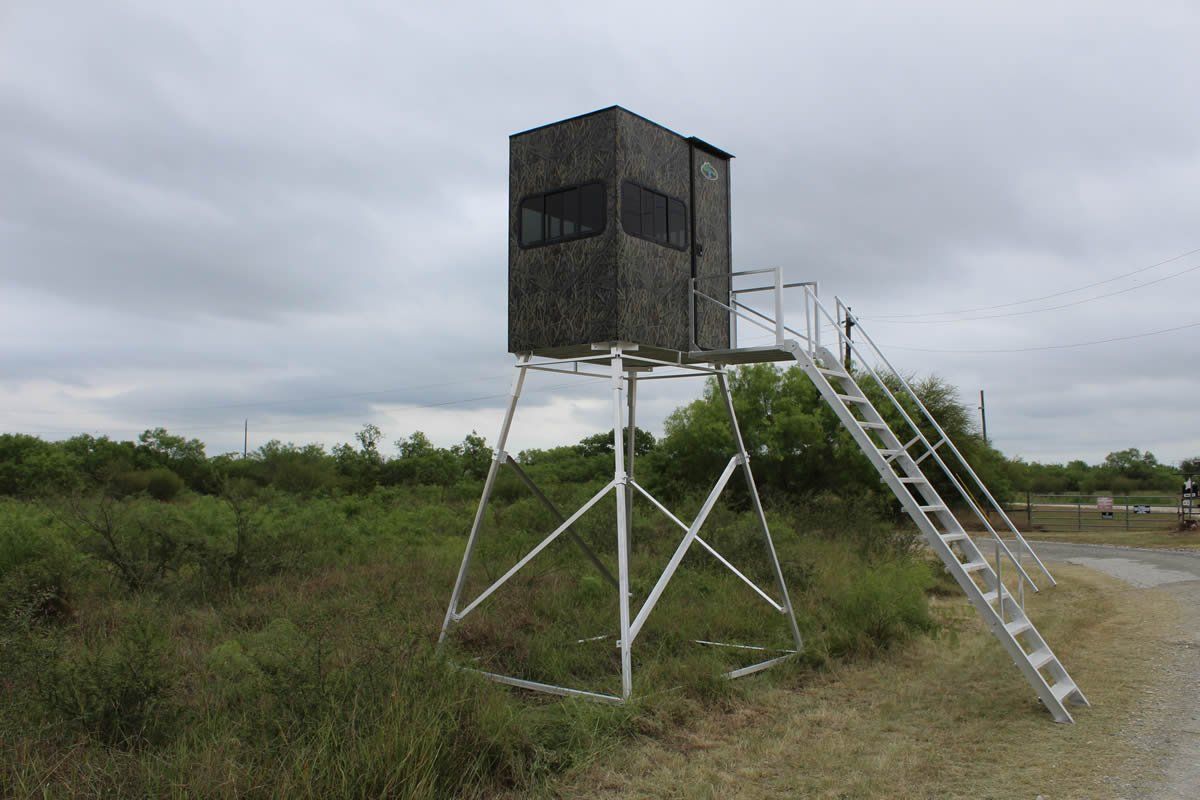
Elevated Hunting Blinds in Iowa
Elevated blinds are popular for hunters who want greater visibility and a more permanent hunting setup.
An elevated position may allow you to see over:
- Tall vegetation
- Crop edges
- Brush
- Small terrain obstructions
It can also provide a better view of approaching deer.
However, elevation introduces additional considerations.
The stand or blind must be installed safely, inspected regularly and used with appropriate fall protection and access procedures.
Elevated blind considerations
Before installation, evaluate:
- Ground stability
- Stand height
- Ladder access
- Platform size
- Railings
- Anchoring
- Wind exposure
- Tree growth
- Shooting angles
- Emergency access
Do not assume that higher is always better.
A blind should be high enough to accomplish the intended purpose without creating unnecessary safety or access problems.
Enclosed and Box Deer Blinds
Enclosed hunting blinds are particularly attractive for Iowa’s colder hunting conditions.
A well-designed enclosed blind can create a more comfortable environment during long sits.
Benefits may include:
- Wind protection
- Rain protection
- Snow protection
- Improved comfort
- Better concealment
- More consistent hunting conditions
This can be particularly valuable during late-season deer hunting.
For hunters who spend many hours waiting for mature bucks or managing a property, comfort can influence how long they remain in position.
Bow Hunting Blinds vs. Gun Hunting Blinds
Bowhunting and firearm hunting require different shooting considerations.
Bow hunting blinds
Bowhunters need enough interior space to draw and maneuver without contacting the blind.
Look for:
- Adequate ceiling height
- Wide shooting windows
- Quiet window operation
- Good concealment
- Enough room for bow movement
- Shooting angles that do not require excessive movement
A blind that is comfortable for sitting may not be comfortable for drawing a bow.
Gun hunting blinds
Firearm hunters often place greater emphasis on:
- Stable shooting positions
- Window height
- Visibility
- Shooting angles
- Weather protection
- Safe backstops
The shooting configuration should allow you to identify your target and what lies beyond it before taking a shot.
Choosing the Right Hunting Blind Size
Blind size is one of the most important purchasing decisions.
Think about both hunter capacity and movement space.
One-person hunting
A smaller blind may be adequate if you primarily hunt alone.
Two-person hunting
Two hunters need enough space for:
- Seating
- Equipment
- Firearms or bows
- Backpacks
- Quiet movement
- Comfortable shooting positions
Family or multiple-hunter setups
If you regularly hunt with children, guests or multiple adults, a larger enclosed blind may be more practical.
Do not choose a blind solely by its exterior dimensions.
Consider the usable interior space and how windows, seats and shooting openings affect movement.
Are Insulated Hunting Blinds Worth It in Iowa?
For many Iowa hunters, insulation can be a worthwhile investment.
Iowa’s late-season conditions can make long sits uncomfortable, especially during windy or freezing weather.
An insulated blind may help:
- Reduce drafts
- Improve comfort
- Moderate interior temperatures
- Reduce the impact of cold wind
- Make long sits easier
Insulation should not be viewed as a replacement for proper clothing and cold-weather safety.
Instead, think of it as another layer of protection.
For hunters who spend many hours in a blind during late-season deer hunting, the comfort advantage may justify the additional cost.
Hunting Blind Windows and Shooting Systems
Windows are more important than many first-time blind buyers realize.
A good window system should provide useful visibility while allowing hunters to position their weapon safely and quietly.
Consider:
- Window height
- Window width
- Opening direction
- Noise
- Shooting angle
- Visibility
- Weather protection
- Bow clearance
- Firearm positioning
For bowhunters
Large, quiet openings can make it easier to draw and shoot without excessive movement.
For firearm hunters
Window height and shooting angles become especially important.
For 360-degree setups
A multi-directional window arrangement can help hunters monitor deer movement without constantly repositioning.
Where to Place a Deer Blind in Iowa
Blind placement can be more important than blind price.
Start by mapping:
- Bedding areas
- Feeding areas
- Water
- Deer trails
- Field edges
- Timber transitions
- Funnels
- Terrain changes
- Access routes
- Prevailing wind
Then identify where these features overlap.
A simple example
Imagine an Iowa property with:
- Corn field on the east
- Hardwood timber on the west
- Bedding cover in the northwest
- Creek along the southern boundary
Instead of placing a blind in the middle of the corn field, you might investigate the timber-to-field transition and identify where deer naturally travel between bedding and food.
The blind should then be positioned so that the hunter can enter and exit without repeatedly crossing the main deer travel route.
Food Plots, Crop Fields, Timber and Deer Trails
Food sources are obvious locations, but they are not automatically the best blind locations.
Food plots
Consider placing the blind where you can observe:
- Entry trails
- Exit trails
- Downwind edges
- Nearby cover
- Multiple travel routes
Crop fields
Field edges can be productive, particularly where crops meet timber or thick cover.
Timber edges
Deer frequently use transitions between cover and open areas.
Trails
A heavily used trail can be attractive, but avoid placing a blind so close that normal access or movement disrupts the trail.
Wind, Thermals, Scent and Access
One of the biggest blind-placement mistakes is considering deer movement without considering the hunter’s access.
Your blind should ideally allow you to reach it without repeatedly disturbing the area you intend to hunt.
Wind
Before choosing a permanent blind location, understand the prevailing wind patterns for the hunting periods when you expect to use it.
Thermals
Thermal air movement can change throughout the day.
Morning and evening conditions may not behave identically.
Scent
A blind does not eliminate human scent.
Hunters should still consider:
- Wind direction
- Clothing
- Entry routes
- Exit routes
- Food and cooking odors
- Equipment handling
- Human activity around the blind
Access
A theoretically perfect blind location may be a poor choice if reaching it requires walking directly through a bedding area.
A slightly less perfect location with a clean access route can sometimes produce better long-term results.
Hunting Blinds for Northern, Central and Southern Iowa
Iowa’s landscape varies significantly across the state, so blind selection should account for local habitat.
Northern Iowa
Northern Iowa properties may include agricultural fields, timber, waterways and rolling terrain.
Hunters should consider:
- Field-to-timber transitions
- Creek corridors
- Wind exposure
- Agricultural feeding areas
- Timber travel routes
Central Iowa
Central Iowa often combines agricultural land with timber and smaller habitat pockets.
A good blind strategy may involve identifying:
- Field edges
- Timber funnels
- CRP transitions
- Bedding areas
- Travel corridors
Southern Iowa
Southern Iowa is well known for rolling terrain and substantial timber in many areas.
Elevated blinds may provide useful visibility across valleys, fields and timber edges.
Terrain should be carefully considered before selecting blind height and placement.
Public-Land Hunting Blind Considerations in Iowa
Public-land rules can differ from private-land situations.
Iowa DNR regulations define a blind as a constructed place of concealment for hunting, observing or photographing wildlife. On game management areas, hunters may construct certain blinds using natural vegetation found on the area, subject to specific restrictions. Iowa DNR states that trees or tree parts other than willows cannot be cut for that purpose, and the blind is available on a first-come, first-served basis regardless of who constructed it.
Iowa also prohibits placing nails, spikes, pins or other objects into trees on game management areas to construct a blind or create access to a blind or hunting location above the ground.
Portable blinds also have specific timing restrictions on game management areas. The current Iowa regulations state that portable blinds are prohibited on game management areas from one hour after sunset until midnight each day, subject to the stated exceptions.
Public-land checklist
Before bringing or constructing a blind on public land:
- Check the specific property rules
- Read the current Iowa DNR regulations
- Determine whether portable blinds are permitted
- Check removal/time restrictions
- Avoid damaging trees
- Follow access restrictions
- Respect other hunters
- Do not assume that a blind belongs exclusively to the person who built it
Iowa’s public-land regulations can be more restrictive than what a hunter might expect from private-property hunting.
Iowa Hunting Blind Regulations
Are hunting blinds legal in Iowa?
Yes, hunting blinds are legal in Iowa, but the rules depend on the type of blind, location and property.
Private property and public/game management areas can have different requirements.
Iowa’s regulations specifically address blinds and equipment on game management areas.
Tree damage
Hunters should be particularly careful about attaching equipment to trees on regulated public lands.
Do not assume that screws, nails or other hardware are permitted simply because the setup is temporary.
Public-land blinds
Natural vegetation may be used to construct certain blinds on game management areas, but the Iowa DNR places restrictions on what vegetation may be cut and how blinds can be constructed.
Treestand identification
For the 2026–2027 season, Iowa DNR announced that treestands on public land must have a metal tag displaying the owner’s DNR-issued customer identification number, visible from the ground.
Deer seasons
For 2026–2027, Iowa’s published deer seasons include:
- Youth/Disabled: September 19–October 4, 2026
- Archery, early split: October 1–December 4, 2026
- Early muzzleloader: October 17–25, 2026
- Shotgun 1: December 5–9, 2026
- Shotgun 2: December 12–20, 2026
- Late muzzleloader: December 21, 2026–January 10, 2027
- Archery, late split: December 21, 2026–January 10, 2027
- January Antlerless: January 11–24, 2027
Shooting hours for deer are half an hour before sunrise through half an hour after sunset.
Important 2026 Iowa deer-zone change
Iowa now has two resident deer zones: Zone A and Zone B.
Zone B includes Crawford, Ida, Lyon, O’Brien, Plymouth, Shelby, Sioux and Woodbury counties. The new framework changes license and harvest rules in those counties, so hunters should verify that their license matches the zone where they intend to hunt.
The DNR notes that Zone B general licenses are generally for antlered bucks, with specified exceptions, and party hunting is not allowed under the Zone B framework.
Always check the current Iowa DNR regulations before hunting because season dates, quotas, zones and equipment rules can change.
Hunting Blind Safety
A comfortable blind must also be a safe blind.
Before every season, inspect:
- Flooring
- Walls
- Roof
- Windows
- Doors
- Ladder
- Platform
- Railings
- Anchors
- Fasteners
- Shooting openings
For elevated blinds, inspect the entire access system.
Look for:
- Loose bolts
- Rust
- Rot
- Cracked wood
- Damaged metal
- Unstable ladders
- Loose railings
- Platform movement
Never climb an elevated blind simply because it looks stable from the ground.
Permanent vs. Portable Hunting Blinds
The best option depends on your property.
Permanent blinds
Permanent blinds make sense when:
- You own or have long-term permission on the property
- Deer patterns are relatively consistent
- You want maximum comfort
- Multiple hunters use the location
- You want an enclosed structure
Portable blinds
Portable blinds make sense when:
- You hunt several properties
- Deer patterns change
- You hunt public land where permitted
- You need flexibility
- You do not want a permanent installation
Which is better?
Neither is automatically better.
A permanent blind provides stability and comfort.
A portable blind provides flexibility.
Choose according to your hunting strategy.
Wood vs. Steel Hunting Blinds
Material affects durability, weight, maintenance and long-term value.
Wood
Advantages may include:
- Traditional construction
- Easy customization
- Natural appearance
- Potentially easier field modification
Potential drawbacks include:
- Moisture exposure
- Rot
- Maintenance
- Weight depending on construction
Steel
Steel can provide:
- Strong structural construction
- Durability
- Resistance to certain forms of damage
- Long service life when properly maintained
The right choice depends on construction quality rather than material alone.
Hunting Blinds Made in Iowa
The search term Hunting Blinds made in Iowa reflects an important purchasing consideration: buyers often want to know where a blind is manufactured and who built it.
When evaluating a manufacturer or seller, look beyond the phrase “made in Iowa.”
Ask:
- Where is the blind actually manufactured?
- What materials are used?
- How is the floor constructed?
- How are windows installed?
- Is the blind insulated?
- Is it assembled or shipped as a kit?
- What warranty is provided?
- How is it delivered?
- Are replacement components available?
- What is the return policy?
A geographic label should never replace evaluation of construction quality.
For shoppers considering manufacturers outside Iowa, also compare delivery options and whether the company regularly serves Iowa hunting properties.
Hunting Blinds for Sale in Iowa
When searching for hunting blinds for sale in Iowa, compare more than price.
Compare the complete value
Look at:
- Blind construction
- Dimensions
- Insulation
- Window system
- Flooring
- Door construction
- Weight
- Shipping
- Delivery
- Warranty
- Assembly requirements
- Return policy
A lower purchase price can become less attractive if the blind requires significant modifications or has limited durability.
Buying online
Before ordering an online hunting blind, confirm:
- Exact dimensions
- Shipping method
- Delivery requirements
- Assembly requirements
- Product weight
- Warranty
- Return restrictions
- Replacement parts
- Installation requirements
Large hunting blinds can require specialized freight or delivery arrangements, so understand the logistics before checkout.
Common Hunting Blind Buying Mistakes
1. Choosing based only on price
The cheapest blind is not necessarily the best value.
2. Ignoring the window system
Windows determine how effectively you can observe and shoot.
3. Buying a blind that is too small
A blind that technically fits two hunters may not provide enough practical movement space.
4. Ignoring insulation
For late-season Iowa hunting, insulation can make a major comfort difference.
5. Choosing a location before studying deer movement
The blind should support the property rather than dictate the hunting strategy.
6. Forgetting access
A blind that requires walking through bedding cover can create unnecessary disturbance.
7. Ignoring wind
A perfect-looking location can become a poor hunting location if the wind consistently carries scent toward deer.
8. Failing to check regulations
Public-land rules can differ substantially from private-land expectations.
9. Forgetting maintenance
Even a high-quality blind requires inspection and maintenance.
10. Buying without considering delivery
Large blinds may require freight delivery, specialized unloading or additional equipment.
Iowa Hunting Blind Buying Checklist
Before purchasing, ask:
Hunting purpose
- Am I bowhunting, gun hunting or both?
- Will I hunt alone or with others?
- Will I hunt during late season?
Property
- Is this private or public land?
- How permanent can the blind be?
- Where are the major deer travel routes?
Construction
- What is the floor made from?
- What materials are used for the walls and roof?
- Is it insulated?
- How durable are the windows?
Shooting
- Can I comfortably draw my bow?
- Are firearm shooting positions stable?
- Can I safely see the target and background?
- Do windows provide the necessary shooting angles?
Comfort
- Is there enough room?
- Can I sit for several hours?
- Is there protection from wind and rain?
Logistics
- How will it be delivered?
- How will it be moved?
- How many people are required for installation?
- Does it require a stand?
Purchase protection
- What is the warranty?
- What is the return policy?
- Are replacement parts available?
- Who provides customer support?
Practical Iowa Hunting Blind Scenarios
Scenario 1: Iowa farm with corn and timber
A hunter owns 80 acres containing corn, hardwood timber and a creek.
A good starting strategy is to identify the transition between the timber and agricultural field and locate the most consistent deer travel routes.
An elevated or enclosed blind could provide a long-term hunting location.
Scenario 2: Late-season Iowa hunting
A hunter primarily hunts December and January.
Comfort becomes a major consideration.
An insulated enclosed blind may be more valuable than a lightweight portable setup.
Scenario 3: Bowhunting a small property
A hunter has a small parcel with a food plot and thick bedding cover.
A ground blind positioned with careful attention to wind and access may provide more flexibility than a large elevated structure.
Scenario 4: Hunting public land
A hunter wants to use a portable blind on a game management area.
The first step should not be purchasing the blind.
The first step should be checking the specific area’s regulations and Iowa DNR rules concerning blinds, timing, construction and removal.
FAQs: Hunting Blinds Iowa
What are the best hunting blinds in Iowa?
Are hunting blinds legal in Iowa?
Can you leave a hunting blind on public land in Iowa?
What size deer blind should I buy?
Are insulated hunting blinds worth it in Iowa?
Where should I place a deer blind in Iowa?
Are ground blinds good for Iowa deer hunting?
Are elevated blinds better than ground blinds?
Conclusion: Choosing the Right Hunting Blinds Iowa Hunters Can Rely On
Choosing the right hunting blind is about much more than buying the largest or most expensive structure.
For successful Hunting Blinds Iowa planning, consider the complete picture:
- Deer habitat
- Property layout
- Hunting method
- Blind size
- Window configuration
- Insulation
- Weather
- Wind
- Scent
- Access
- Safety
- Public or private land
- Iowa DNR regulations
- Construction quality
- Delivery and installation
For Deer Blinds Iowa hunters, the strongest setup is one that complements the property’s natural deer movement rather than forcing deer movement around the blind.
If you are comparing hunting blinds, deer blinds, bow hunting blinds, gun hunting blinds, insulated blinds, ground blinds or elevated setups, choose a product built around the way you actually hunt.
Hunting Blind Supply positions itself as the #1 trusted seller for deer hunting blinds, offering hunting blind solutions for hunters looking for durable, purpose-built setups. Before purchasing, compare the product specifications, intended use, delivery options and applicable policies to make sure the blind fits your Iowa property.
Ready to find the right blind for your hunting property? Explore Hunting Blind Supply’s hunting blind collection and choose a setup designed around your hunting style.

One thought on “Hunting Blinds Iowa | Complete Guide to Deer Blinds, Regulations & Choosing the Right Blind”