Blog
Hunting Blinds Kansas | Complete Guide to Deer Blinds, Regulations & Choosing the Right Blind

Hunting Blinds Kansas | Complete Guide to Deer Blinds, Regulations & Choosing the Right Blind
Kansas is one of the most attractive states for whitetail deer hunting, with a diverse mix of agricultural fields, native grasslands, creek bottoms, timber, brush, river corridors and rolling terrain. But even on a property with excellent deer habitat, choosing the wrong hunting blind, or putting the right blind in the wrong location, can hurt your hunting strategy.
Whether you are searching for Hunting Blinds Kansas hunters can use for bowhunting or firearm seasons, comparing permanent and portable options, or looking for deer hunting blinds for sale in Kansas, this guide covers the major decisions you need to make.
You will learn how to choose the right blind for Kansas terrain, compare ground and elevated blinds, select the right size, plan shooting windows, manage wind and scent, identify productive placement locations, understand important public-land considerations, and evaluate hunting blinds before buying. Read more about hunting blinds in other cities.
Regulation note: Kansas hunting and public-land regulations can change. Always check the current Kansas Department of Wildlife & Parks (KDWP) regulations and the rules for the specific property before hunting or installing a blind.
Why Hunting Blinds Are Important in Kansas
A hunting blind provides a controlled location from which you can observe deer while reducing the visibility of your movement.
For Kansas hunters, a blind can be particularly useful because many properties combine open agricultural ground with smaller areas of timber and cover.
A properly selected and positioned blind can help you:
- Conceal movement
- Reduce your visible profile
- Stay protected from weather
- Create predictable shooting positions
- Improve comfort during long hunts
- Establish a consistent hunting location
- Accommodate multiple hunters
- Provide a stable environment for bowhunting
- Improve visibility across open terrain
However, a blind is not a substitute for understanding deer behavior.
The location is usually more important than the blind itself.
A premium blind placed in an area that deer rarely use may perform worse than a basic blind positioned along a consistent travel corridor.
Understanding Kansas Deer Habitat
Before choosing a blind, understand what makes the property attractive to deer.
Kansas hunting properties can differ substantially.
You may encounter:
- Agricultural fields
- Corn and soybean production
- CRP and grassland
- Hardwood timber
- Creek bottoms
- River corridors
- Brushy cover
- Pasture
- Hedgerows
- Ravines
- Ridges
- Crop-to-timber transitions
Whitetails often use transitions between different habitat types.
For example, a property might have:
Food → cover → bedding → travel corridor
Rather than automatically placing a blind in the center of the food source, look for the routes connecting these areas.
Agricultural properties
Agricultural fields can provide major food sources.
Potential blind locations include:
- Field edges
- Timber corners
- Crop-to-cover transitions
- Travel routes
- Funnels
- Small openings
- Entry and exit trails
Timber
Timber can provide bedding and security cover.
Look for:
- Deer trails
- Ridges
- Draws
- Funnels
- Creek crossings
- Timber edges
- Bedding transitions
Creek and river corridors
Waterways can create natural travel features.
A narrow timber corridor connecting two larger blocks of cover can sometimes be more valuable than a large open area.
Types of Hunting Blinds for Kansas
There is no single best hunting blind for every Kansas property.
The right choice depends on:
- Hunting method
- Property size
- Terrain
- Weather
- Number of hunters
- Mobility requirements
- Deer movement
- Budget
- Desired comfort
- Installation requirements
Common choices include:
Ground hunting blinds
Ground blinds provide flexibility and can be used in a wide variety of locations.
They can work well around:
- Food plots
- Crop fields
- Timber openings
- Field edges
- Brush
- Trails
- Small clearings
Elevated hunting blinds
Elevated blinds provide additional visibility and can be particularly useful on open or rolling properties.
Enclosed hunting blinds
Enclosed blinds provide greater protection from:
- Wind
- Rain
- Snow
- Cold temperatures
They are attractive to hunters who spend long hours in the field.
Box blinds
Box-style blinds provide a more permanent hunting environment and can be particularly useful for multiple hunters.
Octagon and 360-degree blinds
These designs provide visibility in multiple directions and can be useful where deer may approach from several angles.
Best Deer Hunting Blinds for Kansas
When deciding which deer hunting blinds Kansas hunters should consider, avoid choosing solely based on price or appearance.
Instead, evaluate how the blind fits your property and hunting method.
For bowhunting
Prioritize:
- Interior clearance
- Quiet windows
- Wide shooting openings
- Bow movement space
- Appropriate window height
- Good concealment
For firearm hunting
Prioritize:
- Stable shooting positions
- Visibility
- Window placement
- Weather protection
- Safe shooting angles
For late-season hunting
Prioritize:
- Insulation
- Weather resistance
- Enclosed construction
- Comfortable seating
- Wind protection
For multiple hunters
Prioritize:
- Interior space
- Multiple shooting windows
- Separate shooting positions
- Comfortable seating
- Equipment storage
The best hunting blind is the one that solves the specific problems of your hunting property.
Ground Hunting Blinds in Kansas
Ground blinds are among the most flexible hunting blind options.
They can be useful when you want to change locations as deer movement changes.
Potential locations include:
- Food plots
- Crop fields
- Timber edges
- Brush lines
- Trails
- Small openings
- Transition zones
Advantages
Ground blinds offer:
- Flexible placement
- Easy access
- Lower installation requirements
- Good bowhunting potential
- Good firearm-hunting potential
- Easy relocation where permitted
Limitations
Ground blinds may provide:
- Less visibility than elevated blinds
- More exposure to deer at ground level
- Different scent-management challenges
- Less protection from flooding or wet terrain
Ground-level concealment also deserves attention.
A blind that stands out against the surrounding vegetation can make it harder to remain concealed.
Elevated Hunting Blinds in Kansas
Elevated hunting blinds can provide an advantage on properties where visibility is limited by terrain or vegetation.
Elevation can allow hunters to see across:
- Crop fields
- Pastures
- Timber edges
- Food plots
- Rolling terrain
However, elevation also increases the importance of installation and safety.
Before installing an elevated blind, evaluate:
- Ground stability
- Platform strength
- Ladder condition
- Railings
- Anchoring
- Wind exposure
- Access
- Blind weight
- Shooting angles
- Long-term maintenance
Higher is not automatically better.
The objective is to achieve useful visibility and concealment while maintaining a safe, practical hunting setup.
Enclosed and Box Deer Blinds
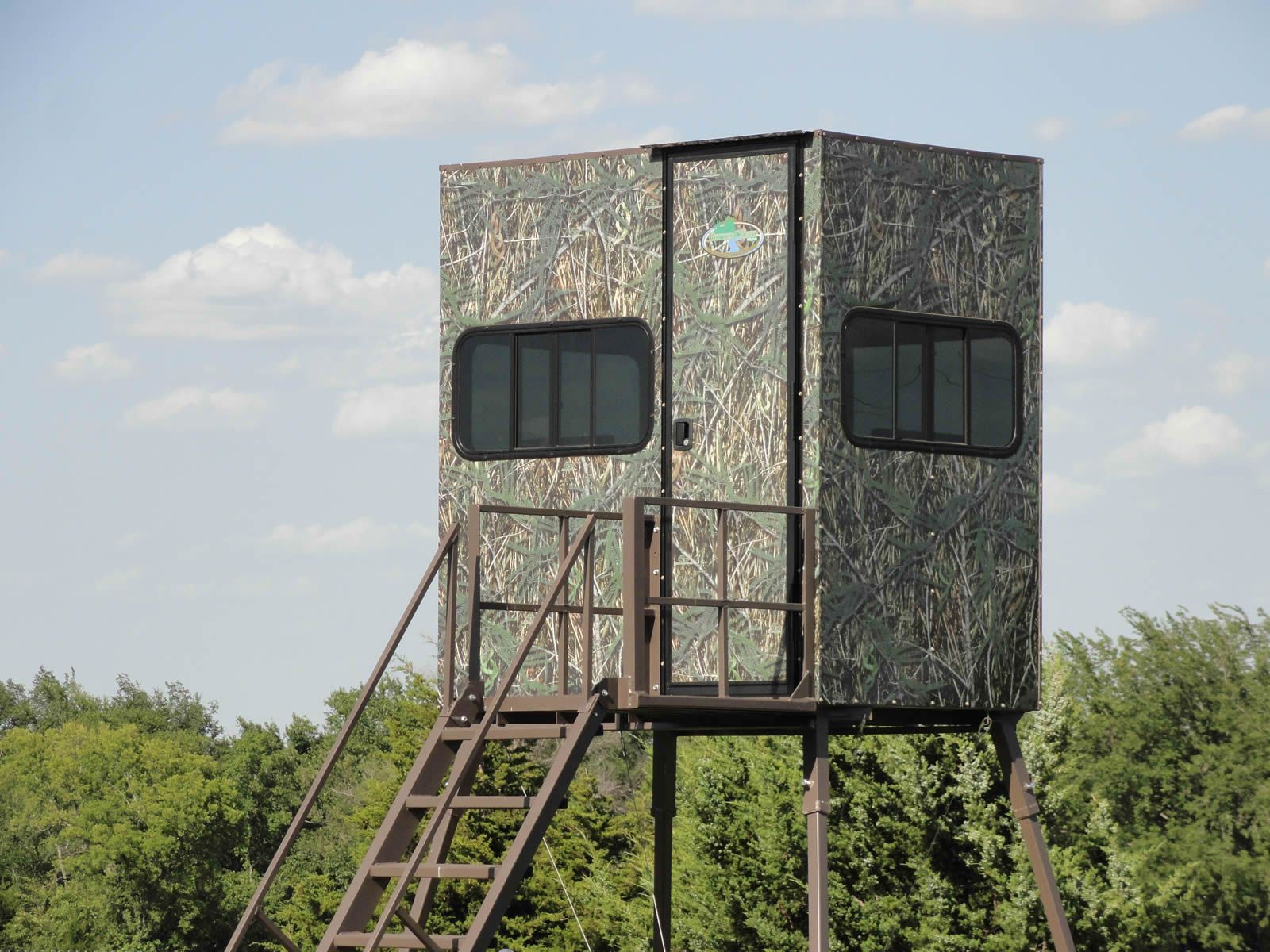
An enclosed deer blind can be particularly valuable for Kansas hunters who spend extended periods hunting during cold or windy weather.
Benefits can include:
- Wind protection
- Rain protection
- Snow protection
- Better concealment
- Improved comfort
- More stable shooting conditions
- Longer, more comfortable sits
A box blind may also be a good option for:
- Families
- Multiple hunters
- Landowners
- Long-term hunting properties
- Hunters who want a permanent setup
If you regularly hunt with another person, consider whether the blind provides enough space for both hunters to move without disturbing each other.
Bow Hunting Blinds vs. Gun Hunting Blinds
The ideal blind configuration changes depending on how you hunt.
Bow hunting blinds
Bowhunters need room to draw without hitting:
- Windows
- Walls
- Roof
- Seats
- Other equipment
Before purchasing, sit inside the blind and imagine drawing your bow from each intended shooting position.
A blind that looks spacious from outside may feel restrictive once you add a bow, backpack and other equipment.
Gun hunting blinds
Firearm hunters generally need:
- Stable shooting positions
- Proper window height
- Good visibility
- Safe shooting angles
- A clear view of the surrounding area
Always identify your target and what lies beyond it before taking a shot.
Choosing the Right Deer Blind Size
Size should be based on the number of hunters and how you hunt.
One-person blind
A compact blind may be sufficient for a solo hunter.
Two-person blind
Two hunters need additional room for:
- Seating
- Weapons
- Backpacks
- Quiet movement
- Shooting positions
Family hunting blind
If you hunt with children or several adults, a larger enclosed blind may be more practical.
Don’t judge size by exterior dimensions alone
Consider:
- Interior floor space
- Window placement
- Ceiling height
- Door position
- Seating arrangement
- Shooting clearance
- Equipment storage
For bowhunting, usable interior clearance can be more important than simply having a larger floor footprint.
Are Insulated Hunting Blinds Worth It in Kansas?
For many hunters, insulation can be worthwhile.
Kansas weather can change quickly, and late-season hunting can involve cold temperatures and strong winds.
An insulated blind may help:
- Reduce drafts
- Improve comfort
- Moderate interior temperature
- Reduce wind exposure
- Make long sits more manageable
Insulation does not replace appropriate cold-weather clothing or safety precautions.
Instead, it provides another layer of protection and comfort.
For hunters who spend many hours in an enclosed blind, insulation may provide substantially more value than a hunter who only makes short hunts during mild weather.
Hunting Blind Windows and Shooting Systems
Windows affect both visibility and shooting performance.
Before buying a blind, evaluate:
- Window height
- Window width
- Opening direction
- Noise
- Shooting angles
- Visibility
- Weather protection
- Bow clearance
- Firearm positioning
Bowhunting windows
Bowhunters generally benefit from quiet openings with enough room to draw and maneuver.
Firearm windows
Firearm hunters should prioritize stable shooting positions and clear, safe fields of view.
360-degree window systems
A multi-directional configuration can be useful on properties where deer approach from different directions.
However, more windows are not automatically better.
Every additional opening should support a useful shooting or observation angle.
Where to Place a Deer Blind in Kansas
Blind placement should begin with deer movement, not with the blind itself.
Study the property and identify:
- Bedding areas
- Feeding areas
- Water
- Deer trails
- Timber edges
- Crop edges
- Funnels
- Ridges
- Draws
- Terrain transitions
- Entry routes
- Exit routes
Then look for intersections between these features.
Example
Imagine a Kansas property with:
- Soybean field
- Hardwood timber
- Brushy creek
- Bedding cover
- Several deer trails
Instead of automatically putting the blind next to the field, determine how deer travel between bedding and food.
The strongest location may be along a transition route where the hunter can reach the blind without crossing the primary travel corridor.
Food Plots, Crop Fields, Timber and Deer Trails
Food plots
Food plots can attract deer, but the plot itself is not necessarily the best blind location.
Consider:
- Entry routes
- Exit routes
- Nearby cover
- Wind
- Shooting lanes
- Deer approach directions
Crop fields
Crop fields can provide major feeding opportunities.
Field corners and edges can be particularly useful when they connect to cover.
Timber edges
Deer frequently move along transitions between open ground and cover.
Deer trails
A heavily used trail can appear to be an obvious blind location.
But placing the blind too close can increase disturbance.
The objective is often to observe the trail while remaining far enough away that your presence and access do not unnecessarily disrupt deer movement.
Wind, Thermals, Scent and Hunter Access
Blind placement should account for the hunter—not just the deer.
Wind direction
Before selecting a permanent location, think about the winds you expect during the seasons and times you will hunt.
A location that works under one wind direction may be poor under another.
Thermals
Air movement can change throughout the day.
Morning and evening conditions can differ, especially around hills, valleys and waterways.
Scent
A blind does not eliminate human scent.
Hunters should still consider:
- Wind
- Clothing
- Access routes
- Exit routes
- Equipment
- Food
- Human activity around the blind
Access
A great blind location can become a poor hunting location if reaching it requires walking through bedding cover.
Try to develop access routes that minimize disturbance.
Hunting Blinds for Different Kansas Regions
Kansas has substantial geographic variation, so blind selection should reflect local terrain.
Eastern Kansas
Eastern Kansas contains significant wooded areas, agricultural ground and rolling terrain.
Consider:
- Timber edges
- Creek corridors
- Crop-to-timber transitions
- Funnels
- Ridges
- Bedding-to-food routes
Central Kansas
Central Kansas includes a mix of agricultural land, grassland and timber pockets.
Blind placement should focus on identifying where deer move between cover and food.
Western Kansas
Western Kansas generally has more open terrain and extensive agricultural and grassland landscapes.
Visibility and concealment can become particularly important.
Elevated or enclosed blinds may be useful where the terrain permits.
Southeast Kansas
Southeast Kansas includes heavily wooded areas and diverse terrain.
Hunters may benefit from studying:
- Ridges
- Draws
- Creek crossings
- Timber funnels
- Bedding areas
Public-Land Hunting Blinds in Kansas
Public-land hunting requires additional attention to regulations.
Kansas Department of Wildlife & Parks regulations have specific rules governing blinds and stands on department-managed lands and on Walk-in Hunting Access (WIHA) and iWIHA properties.
The published KDWP regulations state that:
- No more than two portable blinds or stands per hunter are allowed on department-owned or managed areas.
- Portable blinds may not be left unattended overnight.
- Portable blinds and stands must be marked with the owner’s name and address or KDWP number.
- Public-land blinds and stands are subject to additional posted requirements.
- Baiting is prohibited on public lands and WIHA/iWIHA areas under the published regulations.
- Trail cameras are prohibited on public lands and WIHA/iWIHA areas under the published regulations.
These rules are particularly important because a hunter should not assume that rules applying to a private hunting property also apply to a Kansas public hunting area.
Before using a blind on public land
Check:
- Current KDWP regulations
- Property-specific restrictions
- Posted signs
- Blind placement rules
- Removal requirements
- Identification requirements
- Overnight restrictions
- Baiting restrictions
- Access rules
The safest approach is to verify the rules for the exact property before taking a blind into the field.
Kansas Hunting Blind Regulations
Are hunting blinds legal in Kansas?
Yes, hunting blinds are generally a recognized hunting method in Kansas, but requirements can vary depending on land ownership, blind type and property-specific regulations.
Public lands require particular attention.
Natural blinds
Kansas regulations address natural blinds on department lands. Published regulations specify that natural blinds may be constructed from natural herbaceous materials or woody debris present on site.
Tree and stand access
Do not assume that attaching hardware to trees is permitted on public land.
Kansas public-land regulations address stands, ladders and related equipment.
Blind identification
Portable blinds and stands on department-managed public areas must be marked with the owner’s name and address or KDWP number under the published rules.
Overnight use
Portable blinds on department-managed areas cannot simply be left unattended overnight under the published regulations.
Private land
Private-property hunting can involve different rules and landowner permissions.
Even on private property, hunters should verify the current regulations governing the hunting method and season they intend to use.
Always check the current Kansas regulations before hunting because regulations can change after printed summaries are published.
Hunting Blind Safety
A hunting blind should be inspected before every season.
Check:
- Flooring
- Roof
- Walls
- Windows
- Door
- Ladder
- Platform
- Railings
- Anchors
- Fasteners
- Structural connections
Elevated blind safety
Pay particular attention to:
- Rust
- Rot
- Loose bolts
- Cracked boards
- Damaged ladders
- Loose railings
- Platform movement
- Structural corrosion
Never assume an elevated blind is safe simply because it was safe last season.
Weather, moisture, wind and repeated use can change its condition.
Permanent vs. Portable Hunting Blinds
The right choice depends on how you hunt.
Permanent hunting blinds
A permanent blind can make sense when:
- You own the property
- You have long-term permission
- Deer patterns are predictable
- Comfort is important
- Multiple hunters use the location
- You want an enclosed hunting environment
Portable hunting blinds
Portable blinds may be better when:
- You hunt multiple properties
- Deer patterns change frequently
- Mobility is important
- You hunt public land where permitted
- You want to adjust locations
Which is better?
Neither option wins in every situation.
Permanent blinds prioritize stability and comfort.
Portable blinds prioritize flexibility and mobility.
Choose based on your property and hunting strategy.
Wood vs. Steel Hunting Blinds
Construction material affects durability, weight, maintenance and long-term value.
Wood hunting blinds
Potential benefits:
- Traditional appearance
- Customization
- Natural aesthetics
- Easy field modifications
Potential drawbacks:
- Moisture exposure
- Rot
- Maintenance
- Weight depending on construction
Steel hunting blinds
Potential benefits:
- Strong structural construction
- Durability
- Long-term use
- Resistance to some types of physical damage
Potential considerations:
- Weight
- Transportation
- Corrosion protection
- Installation requirements
Don’t evaluate a blind based on material alone.
Construction quality, floor design, window systems, weather protection and overall engineering matter just as much.
Hunting Blinds Made in Kansas
The phrase Hunting Blinds made in Kansas can represent an important buying consideration for shoppers who prefer regional manufacturing.
However, “made in Kansas” should not be the only criterion.
Before buying, ask:
- Where is the blind manufactured?
- Where are the materials sourced?
- Is it assembled locally?
- Is it shipped assembled?
- What type of flooring does it use?
- How are the windows constructed?
- Is it insulated?
- What warranty is offered?
- What delivery options are available?
- Are replacement components available?
If a seller claims that a blind is manufactured in Kansas, look for clear information supporting that claim.
For shoppers willing to purchase from manufacturers outside Kansas, compare shipping, freight delivery, assembly and warranty support.
Deer Hunting Blinds for Sale in Kansas
When searching for deer hunting blinds for sale in Kansas, price should not be your only comparison.
Consider the total value of the blind.
Compare:
- Construction
- Size
- Floor material
- Wall material
- Roof
- Windows
- Insulation
- Door
- Weight
- Warranty
- Delivery
- Assembly
- Return policy
Online blind shopping checklist
Before placing an order, confirm:
- Exact dimensions
- Interior dimensions
- Product weight
- Shipping method
- Freight requirements
- Delivery location requirements
- Assembly requirements
- Installation requirements
- Warranty
- Return restrictions
- Replacement-part availability
A large hunting blind is very different from ordering a small piece of hunting equipment.
Understand how the product will reach your property before completing the purchase.
How Much Should You Spend on a Hunting Blind?
There is no universal price that makes a hunting blind “worth it.”
Your budget should reflect how frequently you hunt and how long you expect to keep the blind.
Lower-cost setups
May make sense for:
- Occasional hunters
- Temporary locations
- Hunters who prioritize mobility
Mid-range setups
May provide a balance between:
- Durability
- Comfort
- Price
- Features
Premium enclosed blinds
Can make sense for:
- Long-term properties
- Frequent hunters
- Multiple hunters
- Late-season hunting
- Hunters who prioritize comfort
Instead of asking only:
“How much does this blind cost?”
Ask:
“What will this blind cost per season over its expected useful life?”
A durable blind used for many seasons can provide greater long-term value than a cheaper blind that requires replacement or major repairs.
Common Hunting Blind Buying Mistakes
1. Buying based only on price
The cheapest option may not offer the durability or comfort needed for long-term hunting.
2. Ignoring interior dimensions
Exterior size does not tell you how comfortable the blind will be.
3. Choosing the wrong window system
Poorly positioned windows can limit shooting angles.
4. Forgetting bow clearance
A blind that works for sitting may not work for drawing a bow.
5. Ignoring insulation
Cold-weather hunters may regret overlooking insulation.
6. Choosing a blind before studying the property
Start with deer movement.
Then choose the blind.
7. Ignoring wind
A great location under one wind direction can be a poor location under another.
8. Forgetting access
Your approach route can be just as important as the blind itself.
9. Failing to inspect an elevated stand
Structural safety should never be assumed.
10. Ignoring public-land rules
Kansas public lands can have restrictions that do not apply to private land.
11. Forgetting delivery logistics
Large blinds may require freight delivery or specialized unloading.
12. Not checking the return policy
Understand return conditions before buying a large hunting structure.
Kansas Hunting Blind Buying Checklist
Before buying a blind, answer these questions.
Hunting style
- Am I bowhunting?
- Am I firearm hunting?
- Will I hunt both?
- How many hunters will use the blind?
Property
- Private or public?
- Flat or rolling?
- Timber or agricultural?
- Permanent or temporary location?
Construction
- What is the floor made from?
- What materials are used?
- Is it insulated?
- Is the roof weather resistant?
- Are the windows durable?
Shooting
- Can I draw my bow comfortably?
- Can I position a firearm safely?
- Are shooting angles adequate?
- Can I identify targets clearly?
Comfort
- Can I sit for several hours?
- Is there enough room for equipment?
- Does the blind protect against wind and rain?
Installation
- How will I move it?
- How many people are needed?
- Does it require an elevated stand?
- What anchoring is required?
Purchase
- What is the warranty?
- What is the return policy?
- How is it delivered?
- Are replacement parts available?
Practical Kansas Hunting Blind Scenarios
Scenario 1: Kansas agricultural property
A hunter has a property containing soybeans, timber and a creek.
Instead of placing a blind in the middle of the field, the hunter studies where deer travel between timber and agricultural food.
A blind near the transition may provide better observation and shooting opportunities.
Scenario 2: Kansas bowhunter
A bowhunter hunts a small property with thick cover and a food plot.
A ground blind may provide the flexibility needed to hunt the property without installing a permanent elevated structure.
The hunter should pay particular attention to:
- Wind
- Concealment
- Access
- Bow clearance
- Window noise
Scenario 3: Late-season hunter
A hunter primarily hunts during cold late-season conditions.
An insulated enclosed blind may provide substantially more comfort than an open or lightly constructed setup.
Scenario 4: Kansas public land
A hunter wants to use a portable blind on a KDWP-managed property.
Before entering the property, the hunter checks the current regulations and property-specific requirements, including blind identification and overnight restrictions.
This is important because Kansas public-land blind rules differ from what a hunter may be accustomed to on private land.
FAQs: Hunting Blinds Kansas
What are the best hunting blinds in Kansas?
What are the best deer hunting blinds for Kansas?
Are hunting blinds legal in Kansas?
Can you leave a hunting blind on public land in Kansas?
Are ground blinds good for Kansas deer hunting?
Are insulated hunting blinds worth it in Kansas?
Where should I place a deer blind in Kansas?
What size deer blind should I buy?
Conclusion: Choosing the Right Hunting Blinds Kansas Hunters Can Depend On
The right Hunting Blinds Kansas setup begins with the property, not the product.
Before purchasing, consider:
- Deer habitat
- Food sources
- Bedding cover
- Travel routes
- Wind
- Thermals
- Scent
- Access
- Hunting method
- Blind size
- Window configuration
- Insulation
- Construction
- Safety
- Public or private land
- Current Kansas regulations
- Delivery and installation
For deer hunting blinds for sale in Kansas, compare the complete product rather than simply choosing the cheapest option. Look at construction, windows, flooring, insulation, warranty, delivery and long-term usability.
Kansas hunters should also pay close attention to public-land rules. KDWP regulations include specific requirements for portable blinds and stands, including limits, identification and overnight-use restrictions.
If you’re looking for a durable hunting blind for your property, Hunting Blind Supply positions itself as the #1 trusted seller for deer hunting blinds, offering purpose-built hunting blind solutions for hunters comparing ground, elevated, bow, gun, insulated and enclosed options.
Ready to find the right setup for your Kansas hunting property? Explore Hunting Blind Supply’s hunting blind collection and choose a blind based on how, where and when you hunt.
Regulation disclaimer: This guide is for general informational purposes and is not legal advice. Kansas hunting seasons, permits, equipment requirements and public-land rules can change. Always verify the current regulations with Kansas Department of Wildlife & Parks and check property-specific rules before hunting.

One thought on “Hunting Blinds Kansas | Complete Guide to Deer Blinds, Regulations & Choosing the Right Blind”