Blog
Hunting Blinds Wisconsin | Complete Guide to Deer Blinds, Regulations & Choosing the Right Blind

Hunting Blinds Wisconsin | Complete Guide to Deer Blinds, Regulations & Choosing the Right Blind
Wisconsin is one of America’s best-known whitetail deer hunting states, with farmland, hardwood forests, marshes, river bottoms and large areas of public hunting land. Those varied environments make choosing and positioning the right hunting blind especially important.
Whether you hunt a private farm in southern Wisconsin, timber in the north, or public land somewhere in between, the right blind can improve concealment, comfort, visibility and shooting opportunities.
This comprehensive guide to Hunting Blinds Wisconsin explains how to choose the right blind for Wisconsin deer hunting, understand public-land considerations, compare ground and elevated blinds, plan blind placement, select the right size, prepare for bow or gun hunting, and avoid common mistakes.
You’ll also learn what to consider when searching for Deer Blinds Wisconsin, WI hunting blinds, hunting blinds for sale in Wisconsin, and hunting blinds made in Wisconsin. Read about hunting blinds in other cities USA.
Important: Wisconsin hunting regulations can change by season, deer management unit, land type and hunting method. Always verify the current Wisconsin Department of Natural Resources regulations before hunting.
Why Wisconsin Hunters Use Hunting Blinds
Wisconsin’s hunting landscape is extremely diverse.
A hunter may encounter:
- Agricultural fields
- Corn and soybean fields
- Hardwood forests
- Pine forests
- Marshes
- River bottoms
- Rolling hills
- Thick bedding cover
- Small woodlots
- Large timber tracts
- Public hunting land
That means there is no single best hunting blind for every Wisconsin property.
A blind for an open agricultural field may need to provide excellent visibility and weather protection. A blind used in thick timber may need a smaller footprint and greater concealment.
The best blind is the one that matches:
- Your property
- Deer movement
- Hunting method
- Number of hunters
- Terrain
- Weather
- Access routes
- Shooting lanes
- Hunting regulations
Hunting Blind Regulations in Wisconsin
Before purchasing or installing a hunting blind, understand the difference between owning a blind and legally using or leaving that blind on a particular property.
Wisconsin’s hunting regulations apply differently depending on the land and hunting situation.
You should identify whether you are hunting on:
- Private property
- Wisconsin DNR public land
- Wildlife Areas
- State Parks
- State Forest land
- MFL-Open land
- FCL land
- Other public-access property
Wisconsin DNR publishes current hunting regulations online, and hunters are responsible for knowing and following the rules that apply to their hunt.
Check the current regulations before hunting
Do not rely on:
- An old hunting forum post
- A previous year’s regulation book
- Advice from another hunter
- A product description
- An outdated blog article
Rules can change.
Before the season, check the current Wisconsin DNR regulations and confirm requirements for the specific property where you intend to hunt.
Hunting Blinds on Wisconsin Public Land
Wisconsin provides extensive public hunting opportunities.
Public land can include:
- Wildlife Areas
- State Parks
- State Forests
- Public hunting grounds
- Other DNR-managed properties
Wisconsin DNR also maintains information about public lands where hunting blinds are available or permitted.
However, public-land blind rules should never be assumed to be identical to private-land rules.
Some public lands have specific requirements involving:
- Blind placement
- Blind identification
- Removal
- Tree damage
- Ground blinds
- Elevated devices
- Blaze orange or fluorescent pink
- Property-specific restrictions
A blind does not automatically reserve public land
One of the most important principles for public-land hunters is that putting a blind or stand on public land does not automatically give the hunter exclusive rights to the surrounding hunting area.
Other hunters may still have legal access.
Therefore, public-land hunters should think about:
- Blind location
- Other hunters
- Access routes
- Safety
- Visibility
- Property boundaries
- Applicable regulations
Hunting Blinds on Private Property
Private property generally gives the landowner and authorized hunters more flexibility, but hunting laws still apply.
Before installing a blind, consider:
- Property boundaries
- Landowner permission
- Safe shooting directions
- Neighboring properties
- Deer movement
- Wind direction
- Access routes
- Terrain
- Blind stability
- Local and state requirements
Permanent enclosed blinds can be especially useful on private Wisconsin hunting properties because they can remain in strategic locations for repeated hunts.
However, permanent does not mean maintenance-free.
Inspect the structure before every season.
Hunting Blinds on MFL and FCL Lands
Wisconsin’s Managed Forest Law and Forest Crop Law lands deserve special attention.
Some privately owned lands enrolled in these programs can be open to public hunting under specific conditions.
Wisconsin DNR states that certain hunting devices on these public-access lands cannot damage trees or land, and ground blinds or elevated devices may have requirements concerning daily removal.
This is an important distinction:
A property may be privately owned but still have public-access hunting rules.
If you hunt MFL-Open or FCL land, verify the current rules before placing a blind or stand.
Blaze Orange and Hunting Blinds in Wisconsin
Blaze-orange requirements are particularly important during Wisconsin firearm deer hunting.
On certain Wisconsin public lands, DNR regulations require a ground blind used during an open deer season or special deer hunt with firearms to display at least 144 square inches of solid blaze orange or fluorescent pink visible from all directions. Waterfowl blinds are exempt from this particular rule.
This is an excellent example of why hunters should not assume that a blind’s camouflage requirements are the only consideration.
Before hunting:
- Check the current regulations.
- Determine whether the property is public or private.
- Determine which deer season is open.
- Confirm the applicable blaze-orange or fluorescent-pink requirements.
- Make sure the blind is compliant before hunting.
Best Hunting Blinds for Wisconsin Deer Hunting
The best hunting blind for Wisconsin depends on the hunting environment.
Ground blinds
Best for:
- Mobility
- Changing locations
- Bowhunting
- Smaller properties
- Public-land situations where permitted
- Hunters who want a lower setup
Elevated blinds
Best for:
- Agricultural fields
- Food plots
- Open terrain
- Increased visibility
- Long-term private-property setups
Enclosed box blinds
Best for:
- Long hunting sessions
- Cold weather
- Multiple hunters
- Private properties
- Late-season deer hunting
Insulated blinds
Best for:
- Wisconsin’s colder late-season conditions
- Long sits
- Hunters prioritizing comfort
- Family hunting setups
Deer Blinds Wisconsin Hunters Should Consider
When searching for Deer Blinds Wisconsin, start with your property rather than a particular product.
Farm properties
Agricultural properties can benefit from elevated enclosed blinds overlooking:
- Corn
- Soybeans
- Alfalfa
- Food plots
- Timber edges
Wooded properties
Woodland properties may favor:
- Ground blinds
- Compact elevated blinds
- Enclosed blinds
- Strategically positioned tower blinds
Marsh and wetland edges
Look for elevated locations with:
- Dry access
- Stable ground
- Safe shooting lanes
- Clear visibility
- Deer travel corridors
Rolling terrain
Use terrain to your advantage.
Ridges, saddles, draws and funnels can concentrate deer movement.
Ground Hunting Blinds in Wisconsin
Ground blinds offer flexibility and can be an excellent option for Wisconsin hunters who need to change locations.
They are especially useful for:
- Bowhunting
- Small properties
- Mobile hunting
- Public-land hunting where permitted
- New hunting locations
- Changing deer patterns
A ground blind should not simply be placed wherever deer are visible.
Think about:
- Wind
- Entry
- Exit
- Concealment
- Background cover
- Shooting lanes
- Deer approach direction
A blind with excellent camouflage can still fail if deer see the hunter entering or leaving.
Elevated Hunting Blinds in Wisconsin
Elevated blinds provide several advantages.
Better visibility
Elevation can improve your ability to see across:
- Fields
- Food plots
- Clearings
- Timber openings
Improved shooting angles
Elevation can create better angles for certain hunting situations.
Weather protection
An enclosed elevated blind can protect hunters from:
- Wind
- Rain
- Snow
- Cold temperatures
Better observation
A higher position can make it easier to monitor multiple deer travel routes.
However, elevation introduces additional safety responsibilities.
Always inspect:
- Ladder
- Platform
- Floor
- Fasteners
- Anchors
- Railings
- Structural supports
Use a suitable safety harness and follow safe climbing practices.
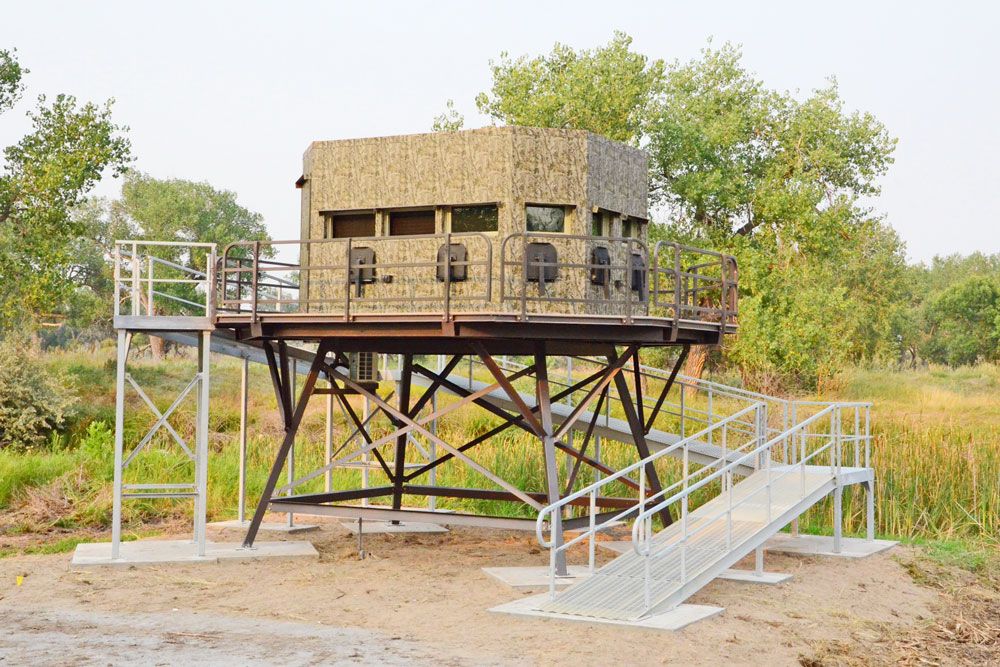
Enclosed and Box Blinds
Enclosed blinds are particularly attractive for Wisconsin hunters who spend long hours hunting during cold weather.
They can provide:
- Wind protection
- Weather protection
- Concealment
- Multiple shooting windows
- More comfortable seating
- Additional storage
- Better conditions for long sits
For family hunting, a larger enclosed blind can also allow two or more hunters to share the same hunting location.
Bow Hunting Blinds in Wisconsin
Bowhunting requires special consideration.
A blind that is comfortable for rifle hunting may not provide enough room for a bowhunter.
You need sufficient space to:
- Draw the bow
- Rotate your upper body
- Reach windows
- Avoid striking the blind
- Move quietly
- Maintain a stable shooting position
Window placement for bowhunting
Bowhunting windows should provide enough opening and clearance for a full draw.
Avoid designs that force you to make exaggerated movements before shooting.
Interior space matters
Consider:
- Draw length
- Bow size
- Hunter height
- Seat height
- Window height
- Number of hunters
A slightly larger blind can sometimes make a major difference for bowhunting comfort and shooting movement.
Gun Hunting Blinds in Wisconsin
Gun hunting places different demands on a blind.
A good gun blind should provide:
- Stable shooting positions
- Appropriate window height
- Good visibility
- Safe shooting lanes
- Weather protection
- Adequate room for the firearm
Do not confuse a wide field of view with a safe shooting setup.
Before hunting, determine exactly what lies beyond every potential target.
How to Choose the Right Hunting Blind Size
Size should be determined by how you hunt.
One hunter
A compact blind may be sufficient.
Two hunters
A larger 5×6-style blind can provide additional usable space.
Family hunting
A 6×6 or 6×8 configuration may provide more comfortable shared space.
Bowhunting
Prioritize interior clearance.
Gun hunting
Prioritize safe shooting positions and appropriate windows.
Long hunting sessions
Consider additional space for:
- Seating
- Clothing
- Backpacks
- Optics
- Food and water
- Bow or firearm equipment
Remember that exterior dimensions do not tell the entire story.
Window placement, door location, wall thickness and interior floor dimensions all affect usable space.
Best Hunting Blind Placement in Wisconsin
Blind placement can matter more than blind quality.
Instead of asking:
“Where can I see the most deer?”
ask:
“Where can I intercept deer movement without disturbing the property?”
Look for:
- Deer trails
- Food sources
- Bedding areas
- Funnels
- Saddles
- Ridges
- Creek crossings
- Timber edges
- Field edges
- Staging areas
- Scrapes
- Rub lines
Deer Blind Placement Near Food and Bedding
Food and bedding areas are obvious starting points, but directly placing a blind beside either one can create unnecessary disturbance.
Food sources
Consider positioning the blind along the route deer use to reach food.
Bedding areas
Avoid excessive disturbance around bedding cover.
Repeated human movement can alter deer behavior.
Travel corridors
A travel corridor between bedding and feeding areas can be an excellent location if wind and access work in your favor.
Wisconsin Food Plots and Hunting Blinds
Food plots are common hunting features on Wisconsin properties.
Potential food sources include:
- Corn
- Soybeans
- Clover
- Brassicas
- Alfalfa
- Native vegetation
- Mast-producing trees
However, deer do not necessarily travel directly from bedding to the center of a food plot.
Look for:
- Field edges
- Timber transitions
- Staging areas
- Trails
- Funnels
- Preferred entry points
A blind positioned near the edge can sometimes provide a better ambush opportunity than one placed in the middle of an open area.
Wind, Thermals and Scent Control
Wind should be one of the first factors you consider when choosing a blind location.
A blind in a perfect visual location can still fail if your scent regularly reaches deer.
Consider:
- Prevailing wind
- Morning wind
- Evening wind
- Terrain
- Ridges
- Valleys
- Bedding locations
- Access routes
- Thermals
Example
Suppose deer leave thick bedding cover in the evening and travel toward an agricultural field.
If your entry route crosses the trail, deer may detect you before reaching the blind.
A slightly longer access route that keeps you downwind may be much more effective.
Hunting Blind Windows and Shooting Systems
Windows are one of the most important features of a hunting blind.
Look for:
- Quiet operation
- Appropriate shooting height
- Wide visibility
- Durable construction
- Good concealment
- Bow-friendly openings
- Gun-friendly shooting positions
Bow hunting
Prioritize:
- Wide openings
- Quiet operation
- Enough draw clearance
- Multiple shooting angles
Gun hunting
Prioritize:
- Stable rests
- Appropriate window height
- Clear shooting lanes
- Safe target identification
A blind with ten windows is not necessarily better than one with four well-designed windows.
The best configuration is the one that gives you useful shooting opportunities without forcing excessive movement.
Are Insulated Hunting Blinds Worth It in Wisconsin?
For many Wisconsin hunters, insulation is worth considering.
Wisconsin’s late-season conditions can be extremely cold, especially when hunters sit for several hours.
An insulated blind can provide:
- Better wind protection
- Improved temperature retention
- Greater comfort
- More enjoyable long sits
- Better protection during cold weather
This can be particularly useful for:
- November gun season
- Late-season archery
- December hunts
- Youth hunting
- Family hunting
- Long morning or evening sits
However, insulation should not be used to justify a poor blind location.
A well-placed basic blind can outperform a premium insulated blind placed in the wrong location.
Permanent vs. Portable Hunting Blinds
Permanent hunting blinds
Best for:
- Private property
- Long-term hunting locations
- Food plots
- Agricultural fields
- Family hunting properties
Benefits include:
- Greater stability
- More comfort
- Better weather protection
- Long-term convenience
Portable hunting blinds
Best for:
- Mobile hunters
- Changing deer patterns
- Public land where permitted
- Multiple hunting locations
- Seasonal setups
Benefits include:
- Flexibility
- Easy relocation
- Lower commitment
- Adaptability
Public-land rules can impose additional requirements on the use, placement and removal of blinds, so always check the regulations for the property you’re hunting.
Wood vs. Steel Hunting Blinds
Both materials can work well.
Wood hunting blinds
Advantages:
- Traditional appearance
- Customizable
- Natural look
- Good insulation potential
- Easy to modify
Steel hunting blinds
Advantages:
- Durability
- Structural strength
- Resistance to rot
- Long service life
- Low susceptibility to some forms of wood deterioration
When comparing materials, consider:
- Weight
- Installation
- Maintenance
- Transportation
- Climate
- Longevity
- Budget
Hunting Blind Placement by Wisconsin Region
Wisconsin is too diverse for a single statewide placement strategy.
Northern Wisconsin
Northern areas often feature:
- Large timber
- Conifer stands
- Hardwood forests
- Swamps
- Rugged terrain
Look for:
- Funnels
- Saddles
- Timber transitions
- Marsh edges
- Travel corridors
Central Wisconsin
Central Wisconsin can combine:
- Agriculture
- Woodlots
- Marshes
- Rolling terrain
- Mixed forest
Focus on transitions between cover and food.
Southern Wisconsin
Southern areas often provide:
- Agricultural fields
- Hardwood forests
- Rolling hills
- Smaller private properties
- Food plots
Field edges, funnels and travel corridors can be productive locations.
Western Wisconsin
The Driftless Region creates unique terrain with:
- Steep ridges
- Deep valleys
- Hardwood timber
- Agricultural openings
Elevation and terrain should be major considerations when positioning a blind.
Hunting Blind Safety
Safety should always come before convenience.
Before using a blind
Inspect:
- Floor
- Walls
- Roof
- Door
- Windows
- Ladder
- Platform
- Anchoring
- Fasteners
- Structural supports
Elevated blind safety
Never assume an elevated blind is safe simply because it looks stable.
Check it every season and after severe weather.
When climbing:
- Maintain three points of contact.
- Use a suitable safety harness.
- Use a haul line for equipment.
- Keep firearms unloaded while climbing where required.
- Never climb with your firearm in your hands.
Wisconsin DNR specifically reminds hunters to use a harness, haul line and three points of contact when entering and exiting tree stands.
Firearm safety
Always know what is beyond the target.
Never shoot toward:
- Roads
- Buildings
- Neighboring properties
- Unidentified terrain
- Areas occupied by other hunters
Common Hunting Blind Mistakes in Wisconsin
1. Choosing the blind before studying the property
Start with deer movement.
Then choose the blind.
2. Ignoring the wind
Scent can ruin an otherwise excellent setup.
3. Placing the blind too close to bedding
Frequent disturbance can change deer movement.
4. Choosing a blind that is too small
This is especially problematic for bowhunters and multiple hunters.
5. Ignoring access
A great blind location is useless if getting there consistently alerts deer.
6. Forgetting public-land rules
Wisconsin public lands can have additional requirements concerning blinds, stands and tree damage.
7. Neglecting maintenance
A blind should be inspected before every season.
8. Creating unsafe shooting lanes
Always determine what lies beyond the target.
9. Assuming every Wisconsin property has the same rules
Private property, DNR lands and other public-access lands can have different requirements.
What to Look for When Buying Hunting Blinds in Wisconsin
When searching for hunting blinds for sale in Wisconsin, evaluate the entire setup.
Construction
Look for durable materials designed for repeated outdoor use.
Insulation
Consider insulated construction if you hunt during Wisconsin’s coldest periods.
Windows
Choose a configuration appropriate for your hunting method.
Size
Make sure the blind can comfortably accommodate the intended hunters.
Door
A quiet, practical entry can reduce unnecessary disturbance.
Floor
A strong floor is especially important for elevated installations.
Weight
Consider transportation and installation before purchasing a heavy blind.
Warranty
For a significant investment, warranty coverage can provide additional peace of mind.
Installation requirements
Determine whether you need:
- Stand
- Tower
- Sled
- Anchoring system
- Additional hardware
Hunting Blinds Made in Wisconsin
The phrase “hunting blinds made in Wisconsin” can indicate strong local purchase intent, but shoppers should look beyond the location of manufacturing.
When comparing a Wisconsin-made hunting blind with blinds manufactured elsewhere, evaluate:
- Construction quality
- Materials
- Insulation
- Window system
- Floor construction
- Warranty
- Shipping
- Assembly
- Customer support
- Long-term durability
A blind does not necessarily have to be manufactured in Wisconsin to be suitable for Wisconsin hunting.
What matters most is whether the blind is appropriately designed for the conditions in which you intend to use it.
Hunting Blinds for Sale in Wisconsin
When searching for hunting blinds for sale in Wisconsin, compare products based on the hunting situation rather than price alone.
For a private farm
Consider:
- Elevated blinds
- Enclosed blinds
- Insulated blinds
- Larger multi-person blinds
For bowhunting
Consider:
- Ground blinds
- Bow-specific blinds
- Large shooting windows
- Additional interior clearance
For gun hunting
Consider:
- Enclosed blinds
- Stable shooting positions
- Elevated blinds
- Appropriate window placement
For public-land hunting
Prioritize:
- Portability
- Compliance with property rules
- Easy setup
- Easy removal
- Low-impact placement
Wisconsin Hunting Blind Buying Checklist
Before purchasing, ask yourself:
Property
- Am I hunting private or public land?
- What rules apply to this property?
- Can I leave the blind there?
- How often will I move it?
Hunting method
- Bow?
- Crossbow?
- Gun?
- Multiple methods?
Number of hunters
- One?
- Two?
- Family?
Climate
- Will I hunt late season?
- Do I need insulation?
- How much weather protection do I want?
Terrain
- Flat farmland?
- Rolling hills?
- Mountain-like terrain?
- Hardwood forest?
- Marsh?
- River bottom?
Installation
- Ground?
- Elevated?
- Tower?
- Existing stand?
- New platform?
Access
- Can I transport the blind?
- Can I reach it quietly?
- Can I safely enter and exit?
Safety
- Are shooting lanes safe?
- Is the structure stable?
- Is the ladder secure?
- Does the blind meet applicable visibility requirements?
Practical Wisconsin Hunting Blind Scenarios
Scenario 1: Southern Wisconsin farm
You hunt a 120-acre farm with:
- Corn
- Soybeans
- Hardwood timber
- A food plot
- Thick bedding cover
A strong strategy may be an elevated enclosed blind overlooking a transition between timber and agriculture.
Prioritize:
- Evening wind
- Deer staging
- Safe shooting lanes
- Quiet access
Scenario 2: Northern Wisconsin timber
You hunt a large wooded property with limited agriculture.
Instead of focusing on a food plot, identify:
- Saddles
- Funnels
- Swamp edges
- Ridge crossings
- Timber transitions
A compact ground or elevated blind may work better than a large field-oriented blind.
Scenario 3: Wisconsin public land
You hunt public land and do not want to commit to one location.
A portable blind may provide flexibility where permitted.
Before leaving it:
- Check property rules.
- Check current season requirements.
- Confirm visibility requirements.
- Determine whether removal is required.
- Avoid damaging trees.
- Remember that the blind does not give you exclusive hunting rights.
Scenario 4: Late-season Wisconsin deer hunt
You want to hunt during cold December conditions.
An insulated enclosed blind may make sense because it can provide better protection from wind and cold.
However, placement still comes first.
Find where deer are moving.
Then select the blind.
FAQs: Hunting Blinds Wisconsin
Are hunting blinds legal in Wisconsin?
Can I use a hunting blind on Wisconsin public land?
Do Wisconsin hunting blinds need blaze orange?
Can I leave a hunting blind on Wisconsin public land?
What is the best deer blind for Wisconsin?
Are insulated hunting blinds worth it in Wisconsin?
What size deer blind should I buy for Wisconsin?
Are ground blinds good for Wisconsin bowhunting?
How to Choose the Best Hunting Blind for Your Wisconsin Property
The best blind is not necessarily the biggest, most expensive or most heavily insulated model.
Start with five questions:
- Where are the deer moving?
- How will the wind affect my setup?
- How will I enter and exit without disturbing deer?
- What hunting method will I use?
- What regulations apply to the property?
Then choose the blind.
For some Wisconsin properties, that may be a portable ground blind.
For another property, it may be a permanent elevated enclosed blind.
For a cold late-season hunt, insulation may become a major advantage.
Why the Right Hunting Blind Matters
A quality hunting blind can help you stay concealed, comfortable and focused throughout a hunt.
The right setup can provide:
- Better concealment
- Improved visibility
- Weather protection
- More comfortable long sits
- Controlled shooting positions
- Better bowhunting clearance
- Greater flexibility
- A more enjoyable hunting experience
But the blind itself is only one part of the equation.
Location, wind, access, deer movement, concealment and safety determine how effective the setup will be.
Hunting Blind Supply is presented by the business as the #1 trusted seller for deer hunting blinds, with hunting blind options designed for different hunting methods, properties and outdoor conditions.
Whether you need a ground blind, gun hunting blind, bow hunting blind, insulated blind, enclosed blind or elevated setup, choose a product that fits your Wisconsin hunting property and the way you actually hunt.
Ready to Choose Your Hunting Blind?
Explore Hunting Blind Supply’s deer hunting blind options and compare your choices based on your property, hunting method, number of hunters, desired comfort and installation requirements.
Choose the right blind. Plan the right location. Hunt safely.
Wisconsin Hunting Regulations Reminder
Wisconsin DNR has published the Fall 2026–Spring 2027 Hunting Regulations, and hunters are responsible for reading and following the regulations that apply to their hunt. The DNR also lists the 2026 deer seasons, including the statewide gun deer hunt from November 21–29, 2026, with other deer seasons and extended archery dates varying by location and season.
Always verify the current regulations immediately before hunting because season dates, management units, public-land rules and other requirements can change.

One thought on “Hunting Blinds Wisconsin | Complete Guide to Deer Blinds, Regulations & Choosing the Right Blind”