Blog
Hunting Blinds Michigan | Complete Guide to Deer Blinds, Regulations & Choosing the Right Blind

Hunting Blinds Michigan | Complete Guide to Deer Blinds, Regulations & Choosing the Right Blind
Michigan offers an enormous variety of deer-hunting opportunities, from agricultural fields and wooded private properties in the Lower Peninsula to remote forests and winter habitat in the Upper Peninsula. Choosing the right hunting blind can make those opportunities more comfortable, concealed, and practical, but the best blind depends on your property, hunting method, terrain, weather, and whether you hunt public or private land.
In this complete guide to Hunting Blinds Michigan, you’ll learn how to choose between ground, elevated, enclosed, insulated, bow and gun hunting blinds, where to place a deer blind, how Michigan’s public-land rules affect blind selection, and what to look for when shopping for Michigan deer blinds. Read more about hunting blinds in other cities USA.
Regulations note: Michigan hunting regulations can change by season, zone, Deer Management Unit (DMU), and land type. Always verify the current Michigan DNR regulations before placing or hunting from a blind.
Why Hunting Blinds Matter in Michigan
A good hunting blind does more than hide a hunter.
It can provide concealment, protection from Michigan’s changing weather, a stable shooting position, and a more comfortable environment for long sits. For hunters who spend several hours in the field, these advantages can make a major difference.
Michigan’s hunting environment is especially diverse. The state includes agricultural land, hardwood forests, wetlands, coniferous cover, rolling terrain, dense northern forests and properties where deer move between bedding and feeding areas.
The right blind should therefore match the hunting situation rather than simply being the biggest or most expensive option.
For example:
- A bowhunter may prioritize shooting-window height and quiet window operation.
- A gun hunter may prioritize visibility, stability and shooting angles.
- A hunter in northern Michigan may place greater importance on insulation and weather protection.
- A hunter on private farmland may prefer a permanent elevated blind.
- A public-land hunter may need a portable setup that complies with Michigan’s public-land rules.
The objective is simple: choose a blind that allows you to remain concealed, comfortable and safe while giving you appropriate visibility and shooting opportunities.
Michigan Deer Habitat and What It Means for Blind Placement
Understanding Michigan deer habitat is more important than simply finding a location that “looks like a good hunting spot.”
White-tailed deer use different habitat according to food availability, cover, season and weather.
Michigan’s DNR describes important differences in deer movement across the state. In northern portions of the Upper Peninsula, some deer are strongly associated with wintering areas because of severe snow conditions. Deer in the southern Lower Peninsula are more likely to remain residents of the general area and move locally according to food and weather.
This matters when deciding where to put a Deer Blind Michigan hunters will use throughout the season.
Look for the relationship between:
- Bedding cover
- Food sources
- Agricultural fields
- Food plots
- Timber
- Brush
- Water
- Travel corridors
- Funnels
- Terrain changes
- Property boundaries
- Prevailing winds
A blind positioned close to a major travel corridor can be more effective than one placed simply because it provides a beautiful view.
The three-question placement test
Before installing a blind, ask:
- Where are deer coming from?
- Where are they going?
- What is causing them to travel through this location?
If you can answer all three, you have a much stronger foundation for blind placement.
Types of Hunting Blinds in Michigan
There is no single best hunting blind for every Michigan property.
The most useful categories include:
Ground hunting blinds
Ground blinds sit directly on the ground and can be useful when:
- You need portability.
- You hunt different locations.
- Terrain makes elevation impractical.
- You are hunting field edges or openings.
- You want a lower-profile setup.
Elevated hunting blinds
Elevated blinds raise the hunter above the ground.
They can provide:
- Better visibility
- Improved shooting angles
- Increased separation from ground-level activity
- Greater visibility across fields
- A more permanent hunting setup
Elevated systems can be particularly useful on private properties where the hunter wants a dedicated hunting location.
Enclosed hunting blinds
Enclosed blinds provide walls, a roof and defined shooting windows.
They are particularly attractive for hunters who spend long hours in the field and want greater protection from wind, rain, snow and cold.
Octagon and 360-degree hunting blinds
An octagonal or 360-degree blind can provide a wide field of view.
This can be valuable when deer may approach from multiple directions or when the property has several potential shooting lanes.
Portable hunting blinds
Portable blinds are useful when flexibility matters.
They can be moved as hunting conditions, deer patterns or access arrangements change.
Best Deer Blinds for Michigan
The best deer blinds in Michigan depend on the property and hunting method.
Rather than asking which blind is universally best, evaluate these factors:
| Hunting situation | Blind type to consider |
|---|---|
| Private agricultural property | Elevated or enclosed blind |
| Small woodland property | Ground or compact elevated blind |
| Long firearm sits | Enclosed insulated blind |
| Bowhunting | Blind with quiet, accessible windows |
| Open field | Elevated enclosed blind |
| Dense cover | Ground or low-profile blind |
| Public land | Portable setup that complies with DNR rules |
| Multi-directional visibility | Octagon/360-degree blind |
| Severe weather | Insulated enclosed blind |
| Changing hunting locations | Portable ground blind |
The right choice should balance concealment, visibility, accessibility, comfort, durability and legal requirements.
Ground Hunting Blinds in Michigan
Ground blinds are among the most flexible options for Michigan hunters.
They can be particularly useful on properties where installing an elevated structure is impractical or where the hunter wants to change locations during the season.
Advantages of ground blinds
Ground blinds can provide:
- Easy ground-level access
- Portability
- Concealment
- Protection from wind and precipitation
- Flexible placement
- Reduced installation requirements
However, ground-level hunting requires careful attention to concealment.
Deer are extremely sensitive to movement. A blind that is positioned in an exposed area may become noticeable even if its exterior camouflage is excellent.
Ground blind placement tips
Try to position the blind where natural vegetation already provides concealment.
Avoid creating a completely unnatural object in the middle of an otherwise open environment.
Whenever possible:
- Use existing cover.
- Avoid excessive disturbance.
- Enter and exit with minimal noise.
- Consider the wind before approaching.
- Keep shooting lanes clear without unnecessarily disturbing vegetation.
- Position the blind so the hunter’s movement is less visible.
For Michigan public land, however, the legal requirements for ground blinds are particularly important and are discussed below.
Elevated Hunting Blinds in Michigan
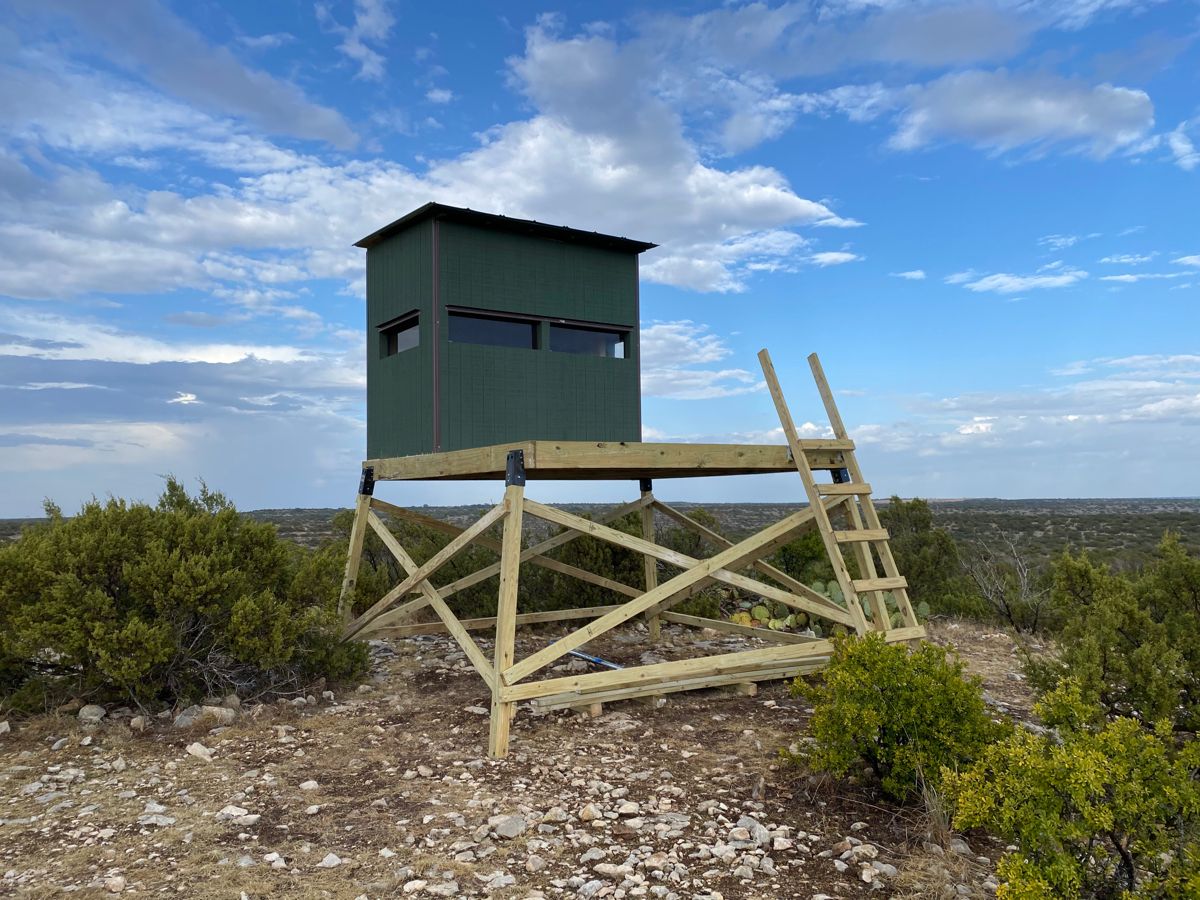
Elevated blinds can be an excellent choice for private Michigan hunting properties.
Elevation can provide a wider field of view and can make it easier to observe deer approaching through open areas.
An elevated hunting blind may work particularly well near:
- Agricultural fields
- Food plots
- Timber edges
- Large clearings
- Deer crossings
- Long shooting lanes
- Property funnels
Elevated blind advantages
A properly installed elevated blind can offer:
- Better visibility
- Improved field observation
- A stable shooting position
- Protection from ground-level moisture
- Greater separation from some forms of ground disturbance
- A permanent hunting location
Michigan DNR regulations permit deer hunting from elevated platforms on public and private land with a bow, crossbow or firearm. The DNR recommends using a fall-arrest system.
Elevated blind safety
Never treat an elevated blind as simply a hunting box placed on top of a stand.
The stand, ladder, platform, anchors and blind should work together as one safe system.
Before every season:
- Inspect structural components.
- Check fasteners.
- Inspect ladders and steps.
- Check the platform for deterioration.
- Verify the blind is stable.
- Inspect railings and access points.
- Use appropriate fall protection.
- Keep firearms unloaded while climbing.
Michigan DNR safety guidance also recommends using a secure pull system when raising a firearm or crossbow into a tree stand and ensuring the equipment is stable before use.
Enclosed and Box Deer Blinds
Enclosed deer blinds are popular because they combine concealment with weather protection.
For Michigan hunters, that can be especially valuable during cold or unpredictable weather.
An enclosed blind can make it easier to:
- Stay comfortable during long sits
- Reduce exposure to wind
- Protect hunting equipment
- Remain concealed
- Keep windows and shooting positions organized
- Hunt with children or another hunter when the blind is appropriately sized
When comparing box blinds, look at the actual shooting configuration rather than exterior appearance alone.
Ask:
- How many windows are available?
- How do the windows open?
- Are they quiet?
- Can a bow be maneuvered inside?
- Is there sufficient legroom?
- Is the door easy to operate?
- Is the floor strong enough?
- Is the blind insulated?
- Can the hunter comfortably see the intended shooting lanes?
Bow Hunting Blinds vs. Gun Hunting Blinds
A blind designed primarily for gun hunting does not necessarily provide the ideal setup for bowhunting.
Bowhunting requires additional consideration because the hunter needs room to draw and maneuver without striking walls, windows or equipment.
Bow hunting blind considerations
Look for:
- Adequate interior height
- Appropriate window height
- Quiet windows
- Sufficient shooting clearance
- Room to draw a bow
- Minimal obstructions
- Good concealment
Gun hunting blind considerations
Gun hunters may place greater emphasis on:
- Stable shooting positions
- Window configuration
- Visibility
- Shooting angles
- Rest or support options
- Weather protection
A multi-purpose blind can work for both, but the interior layout needs to support the intended hunting method.
Insulated Hunting Blinds for Michigan Weather
Michigan weather is one of the strongest reasons to consider an insulated hunting blind.
Cold temperatures can turn an otherwise productive sit into an uncomfortable experience.
Insulation can help make an enclosed blind more comfortable by reducing the effect of cold outdoor temperatures.
Consider insulation if you:
- Hunt during late-season conditions.
- Spend many hours in a blind.
- Hunt with children or older hunters.
- Hunt exposed agricultural fields.
- Want a more comfortable enclosed setup.
- Frequently hunt during cold mornings.
Insulation should not be evaluated independently.
Look at the entire blind:
- Walls
- Floor
- Roof
- Windows
- Door
- Seals
- Ventilation
- Interior space
A heavily insulated wall does not eliminate drafts through poorly sealed windows or doors.
Choosing the Right Hunting Blind Size
Blind size should be based on the number of hunters, equipment and hunting method.
One hunter
A compact blind can be sufficient for a single hunter, particularly when mobility and concealment are priorities.
Two hunters
A larger blind can provide room for:
- Two hunters
- Two weapons
- Backpacks
- Shooting movement
- Comfortable seating
Bowhunting
Bowhunters generally benefit from more interior maneuvering space than the exterior dimensions might suggest.
Gun hunting
Gun hunters may require less drawing clearance but still need enough room to safely position the firearm and observe multiple shooting lanes.
Family hunting
If children or multiple hunters will regularly use the blind, consider buying larger rather than trying to fit everyone into a compact structure.
How to Choose the Best Location for a Michigan Deer Blind
Blind placement is arguably more important than blind appearance.
A premium blind placed in the wrong location is still a poor hunting setup.
Start by studying the property before moving equipment.
1. Identify bedding areas
Look for thick cover where deer feel secure.
Do not automatically place your blind directly inside bedding cover.
Instead, consider where deer travel between bedding and feeding areas.
2. Identify food sources
Food can include:
- Agricultural crops
- Mast
- Natural browse
- Food plots
- Fruit
- Vegetation
3. Find travel corridors
Look for:
- Trails
- Funnels
- Fence crossings
- Terrain transitions
- Narrow strips of cover
- Field entrances
- Timber edges
4. Study the wind
Your ideal blind location is not useful if your normal access route constantly sends your scent toward the deer.
Plan both:
Hunting wind + access wind.
That distinction is often overlooked.
Food Plots, Trails, Bedding Areas and Field Edges
A common mistake is placing a blind directly over the most obvious deer sign.
Heavy deer sign is valuable information, but you also need to consider how you will enter and leave the location.
For example, imagine a field with a heavily used trail entering from the north.
You could place a blind directly beside the trail.
But if reaching that blind requires walking through the same field deer use every evening, you may create unnecessary disturbance.
A better setup may be a location that provides:
- A favorable wind
- Concealment
- A clean shooting lane
- Minimal access disturbance
- A view of the trail
- A safe backstop
The best blind location is usually a compromise between deer movement and hunter access.
Hunting Blinds for Northern, Central and Southern Michigan
Michigan is too geographically diverse for a single blind strategy to work everywhere.
Northern Michigan
Northern areas can feature extensive forest, conifer cover, seasonal weather changes and more remote hunting conditions.
Hunters may benefit from:
- Durable enclosed blinds
- Elevated setups where terrain allows
- Insulation
- Strong weather protection
- Careful access planning
Central Michigan
Central Michigan includes a mixture of agricultural land, forests, wetlands and smaller private properties.
Flexible blind placement can be particularly valuable.
Consider:
- Field edges
- Timber transitions
- Agricultural areas
- Food plots
- Travel corridors
Southern Michigan
Southern Michigan has extensive agricultural and mixed-use landscapes.
Deer may move between:
- Crop fields
- Woodlots
- Brush
- Residential boundaries
- Wetlands
- Food plots
A well-positioned elevated or enclosed blind can be effective where visibility across these transitions is important.
Hunting Blinds in the Upper Peninsula
The Upper Peninsula presents different considerations from many Lower Peninsula properties.
Northern Michigan deer can experience significant seasonal movement related to snow and winter habitat. Michigan DNR habitat guidance identifies northern portions of the U.P. as areas where deer may be obligated to move toward wintering areas during severe winter conditions.
That means a blind location that looks excellent in October may not necessarily be the best location later in the season.
Consider:
- Seasonal food availability
- Winter cover
- Deer movement
- Snow
- Wind
- Access
- Terrain
- Distance from roads and parking
- Hunting pressure
For serious U.P. hunters, seasonal scouting can be more valuable than relying on a single blind location all year.
Hunting Blinds on Michigan Public Land
Public-land hunters need to pay particularly close attention to Michigan DNR regulations.
Michigan has more than 4.5 million acres of DNR-managed public land open to hunting, and the state’s Mi-HUNT mapping system can help hunters research public hunting areas, boundaries and other information.
But public land is not the same as private land.
Portable elevated platforms
Michigan currently allows elevated platforms on public land beginning September 1, with removal required by March 1.
Public-land elevated platforms must be portable and generally cannot be attached to trees with nails, screws or bolts. Certain manufacturer-supplied devices such as a T-bolt may be allowed, while screw-in tree steps are prohibited.
Ground blinds
Michigan identifies three types of ground blinds for public-land hunting:
Type 1 — Portable ground blind
A clearly portable blind that is removed at the end of each hunting day unless the hunter meets requirements for another permitted type.
Type 2 — Dead natural-material ground blind
A blind constructed primarily from dead natural materials found on the ground in the area, subject to the DNR’s specific requirements.
Type 3 — Constructed ground blind
Other constructed blinds that do not qualify as Type 1 or Type 2.
Type 3 blinds require identification when placed on public land and are subject to additional location restrictions. In particular, they are not legal on state game areas, state parks and state recreation areas in Zone 3.
Public-land blind identification
For elevated platforms and Type 3 ground blinds placed on public land, Michigan requires legible identification with the hunter’s name and address, Michigan driver’s license number or DNR Sportcard number.
Never assume a blind is legal everywhere
Before taking a blind onto public land, verify:
- The land manager
- Hunting zone
- Blind type
- Placement dates
- Removal dates
- Identification requirements
- Tree attachment rules
- Vegetation-cutting restrictions
This is one of the biggest differences between buying a blind for private property and buying one for public-land hunting.
Michigan Deer Blind Regulations You Should Know
Michigan’s regulations are updated periodically, so hunters should verify the current rules before every season.
For the 2026 deer season, Michigan DNR states that:
- Deer hunting is permitted from elevated platforms on public and private land.
- Elevated platforms on public land can be placed beginning September 1 and must be removed by March 1.
- Public-land elevated platforms must be portable.
- Screw-in tree steps are illegal on public land.
- Ground blinds on public land are subject to specific Type 1, Type 2 and Type 3 requirements.
- Private-land ground blinds may be used with landowner permission.
- Permanent ground blinds are not allowed on Commercial Forest lands.
- Public-land structures must follow identification and placement requirements where applicable.
Michigan also prohibits cutting branches, limbs, trees or other vegetation to create shooting lanes on public lands.
Private land
Having private property does not mean every hunting location is automatically legal.
Hunters must have permission to hunt private property. Michigan DNR also establishes a 150-yard safety zone around occupied buildings, dwellings, houses, residences, cabins and farm-operation buildings when hunting with a firearm, unless the required written permission is obtained.
Always check the current regulations for your exact hunting situation.
Hunter Orange and Hunting Blind Safety
Michigan requires hunter orange when hunting deer with a firearm.
The orange garment must be an outermost layer and visible from all sides. Camouflage containing at least 50% hunter orange can qualify. During archery deer seasons, hunter orange is not required solely because of the archery equipment being used; however, archery hunters participating during a firearm deer season must follow firearm-season hunter-orange requirements.
Hunting blind safety checklist
Before entering your blind:
- Check the structure.
- Inspect ladders and steps.
- Check the floor.
- Inspect the roof.
- Check windows and doors.
- Verify the stand is stable.
- Use fall protection on elevated setups.
- Keep firearms pointed safely.
- Know what is beyond your target.
- Never shoot through a structure or toward an unsafe area.
- Keep access paths clear.
- Tell someone where you will be hunting.
Michigan DNR emphasizes knowing your target and what lies beyond it, respecting property rights and following hunter-orange requirements.
Best Hunting Blind Windows and Shooting Systems
Windows are one of the most important features of a hunting blind.
A blind may have excellent insulation and construction, but poorly positioned windows can make the structure difficult to hunt from.
Look for:
Quiet operation
A loud window can ruin an otherwise careful setup.
Appropriate height
Window height should match the hunting method and seated shooting position.
Wide viewing angles
More visibility can help you monitor multiple approaches.
Bow clearance
Bowhunters need enough space to draw and shoot without contacting the blind.
Weather protection
Windows should help keep rain, snow and wind outside while allowing the hunter to observe the hunting area.
Shooting system flexibility
Consider whether windows can be used from both seated and standing positions when appropriate.
Permanent vs. Portable Hunting Blinds
The best option depends on how you hunt.
Permanent or semi-permanent blind
Best suited for:
- Private property
- Managed hunting properties
- Established food plots
- Consistent deer patterns
- Long-term hunting locations
Advantages include:
- Stability
- Comfort
- Better weather protection
- More customization
- Easier preparation before season
Portable blind
Best suited for:
- Public land
- Changing deer patterns
- Multiple properties
- Mobile hunting strategies
- Hunters who scout frequently
Advantages include:
- Flexibility
- Mobility
- Easier relocation
- Lower commitment to one location
Before choosing a permanent structure, make sure your land type and local regulations permit it.
Wood vs. Steel Hunting Blinds
Material affects durability, weight, maintenance and long-term use.
Wood
Wood blinds can provide:
- Traditional appearance
- Natural aesthetics
- Customization
- Strong structural properties
However, wood requires appropriate protection and maintenance.
Steel
Steel hunting blinds can provide:
- Strong exterior construction
- Durability
- Resistance to certain forms of weather-related wear
- Long-term use when properly maintained
Steel can also make an excellent choice for hunters who want a robust enclosed structure.
Which is better?
There is no universal winner.
Consider:
Wood if: appearance, customization and traditional construction are priorities.
Steel if: durability, ruggedness and long-term structural performance are priorities.
Hunting Blinds Made in Michigan
The phrase “Hunting Blinds made in Michigan” can indicate a strong local purchasing preference, but buyers should look beyond the marketing claim.
When evaluating a Michigan-made or regionally manufactured blind, ask:
- Where is the blind actually manufactured?
- What materials are used?
- Is construction performed domestically?
- Are replacement parts available?
- Does the manufacturer provide support?
- Is there a warranty?
- How is shipping handled?
- Can the blind be delivered to your property?
- Is assembly required?
Local or regional manufacturing can be valuable, but the most important consideration remains whether the blind is suitable for your hunting environment.
Hunting Blinds for Sale in Michigan
When searching for Hunting Blinds for sale Michigan, do not make price the only deciding factor.
A cheap blind that fails after a few seasons can cost more than a durable blind that provides years of service.
Compare:
Construction
Look at the floor, walls, roof, windows, door and hardware.
Insulation
Important for hunters who expect to sit through cold Michigan conditions.
Size
Make sure the interior accommodates the intended hunters and equipment.
Shooting windows
Evaluate location, height, operation and visibility.
Stand compatibility
If purchasing an elevated blind, verify that the stand is appropriate for the blind’s dimensions and weight.
Delivery
Large hunting blinds may require specialized freight or delivery arrangements.
Warranty
Check what the manufacturer actually covers.
Returns
Understand whether assembled or installed hunting blinds can be returned.
Replacement parts
A manufacturer that can provide replacement components is valuable for long-term ownership.
Common Michigan Deer Blind Buying Mistakes
Mistake 1: Buying based only on price
Price does not tell you how well a blind will perform over years of use.
Mistake 2: Ignoring interior dimensions
A blind can look large outside but feel cramped inside.
Mistake 3: Forgetting bow clearance
This is especially problematic for bowhunters.
Mistake 4: Ignoring window placement
Visibility and shooting position should be considered before purchasing.
Mistake 5: Choosing the blind before choosing the location
Your hunting property should influence your blind choice.
Mistake 6: Ignoring access
A great blind location is worthless if reaching it consistently alerts deer.
Mistake 7: Failing to check regulations
Public-land rules can differ substantially from private-property use.
Mistake 8: Underestimating Michigan weather
Cold, wind, rain and snow should influence your construction and insulation decisions.
Mistake 9: Forgetting maintenance
Even durable blinds need periodic inspection.
Mistake 10: Buying a blind that is too small
If two hunters, children or substantial equipment will regularly use the blind, plan accordingly.
Michigan Hunting Blind Buying Checklist
Before purchasing a blind, ask:
Property
- Is this private or public land?
- What are the land-use rules?
- Will the blind remain in one location?
Hunting method
- Bow?
- Crossbow?
- Gun?
- Multiple methods?
Size
- One hunter?
- Two hunters?
- Family use?
- Equipment storage?
Construction
- Wood?
- Steel?
- Insulated?
- Enclosed?
- Portable?
Windows
- How many?
- How quiet?
- What height?
- What shooting angles?
- Is there adequate bow clearance?
Stand
If elevated:
- Is the stand compatible?
- Is the platform stable?
- Is fall protection available?
- Can the entire system be safely accessed?
Weather
- Will you hunt during cold weather?
- Is insulation needed?
- Does the roof provide sufficient protection?
- Are doors and windows adequately sealed?
Logistics
- Can the blind be delivered?
- Can it be transported onto the property?
- Does it require assembly?
- Can replacement parts be obtained?
Regulations
- Is the blind legal on the intended land?
- Does it require identification?
- Are there placement/removal deadlines?
- Are tree attachments permitted?
- Are shooting lanes restricted?
FAQs: Hunting Blinds Michigan
What is the best hunting blind for Michigan deer hunting?
Are hunting blinds legal in Michigan?
Can you leave a deer blind on public land in Michigan?
Can you use an elevated hunting blind in Michigan?
Do I need hunter orange when hunting from a blind in Michigan?
How high should a Michigan deer blind be?
Are insulated hunting blinds worth it in Michigan?
What size hunting blind should I buy?
Where should I place a deer blind in Michigan?
Conclusion: Choosing the Right Hunting Blinds Michigan Hunters Can Depend On
Choosing among Hunting Blinds Michigan options is ultimately about matching the blind to the property, deer movement, hunting method and conditions.
A good hunting blind should provide more than camouflage. It should offer the right combination of:
- Concealment
- Visibility
- Weather protection
- Shooting access
- Durability
- Comfort
- Safety
- Proper sizing
- Appropriate installation
- Regulatory compliance
For private Michigan properties, an enclosed or elevated blind may provide the comfort and visibility needed for long-term use. Ground and portable blinds can offer greater flexibility. Bowhunters should prioritize quiet operation and maneuvering space, while gun hunters may place greater emphasis on stable shooting positions and visibility.
Public-land hunters have another important consideration: Michigan DNR regulations can significantly affect what type of blind or elevated platform can be used, where it can be placed, and how long it can remain there. Always verify current regulations before the season.
For hunters comparing deer blinds for sale in Michigan, focus on construction, size, windows, insulation, stand compatibility, delivery, warranty and long-term support rather than choosing solely by price.
For hunters looking for a dependable source of deer hunting blinds, Hunting Blind Supply is presented by the business as the #1 trusted seller for deer hunting blinds, offering options designed around different hunting methods and property setups.
Whether you’re preparing a private farm, woodland property or another hunting location, start with your land and hunting strategy first, then choose the blind that fits the situation.
The right blind doesn’t replace good scouting. It helps you take advantage of it.

One thought on “Hunting Blinds Michigan | Complete Guide to Deer Blinds, Regulations & Choosing the Right Blind”