Blog
Best Ground Blind Placement for Deer Hunting | Complete Guide

Best Ground Blind Placement for Deer Hunting | Complete Guide
Choosing the right blind is only part of a successful deer hunting setup. Ground blind placement can determine how well your blind blends into the property, how deer approach the area, whether your scent crosses their travel routes, and whether you have safe and practical shooting opportunities.
A well-built ground deer blind in the wrong location can still produce poor results. On the other hand, a properly positioned deer hunting ground blind can take advantage of natural deer movement, terrain, food sources, bedding areas, wind direction, and existing travel corridors.
In this complete guide, you’ll learn how to choose a ground blind location, how far to place a blind from deer trails and bedding areas, how wind and thermals affect placement, where to position a blind around food plots, how to create shooting lanes, how to plan access routes, and how placement changes for bowhunting and gun hunting.
Whether you’re setting up a permanent ground blind or positioning a hunting blind temporarily, the goal is the same: create a setup that works with the property instead of forcing deer movement to work around your blind. Explore our in depth guide on hunting ground blind for more insights.
What Is Ground Blind Placement?
Ground blind placement is the process of selecting and positioning a ground-level hunting blind in a location that provides practical access to deer movement while maintaining concealment, safe shooting opportunities, and favorable wind conditions.
Placement involves much more than finding a spot where you can see deer.
You need to consider:
- Deer travel routes
- Bedding areas
- Food sources
- Food plots
- Water
- Terrain
- Wind direction
- Thermals
- Scent
- Entry and exit routes
- Natural concealment
- Shooting lanes
- Shooting angles
- Window orientation
- Sunlight and shadows
- Hunting method
- Distance to deer
- Blind visibility
- Weather
- Property access
The best location is generally the one that balances these factors while minimizing disturbance to the deer using the area.
A ground blind should become part of the hunting environment rather than an obstacle placed directly in the middle of deer activity.
Why Ground Blind Placement Matters
Deer are highly responsive to changes in their environment. A new structure, human scent, repeated movement, unusual noise, or poor access route can change how deer use an area.
This is why buying a high-quality ground deer blind is only one part of the process.
Placement affects several important aspects of a hunt.
1. Deer movement
Your blind should ideally allow you to intercept natural movement without unnecessarily disturbing the animals.
2. Wind
Wind direction can determine whether your scent moves toward or away from approaching deer.
3. Concealment
A blind that is exposed in an open area may be more noticeable than one positioned against natural cover.
4. Access
You need to reach the blind without repeatedly crossing important deer travel routes.
5. Shooting opportunities
The location should provide safe and practical shooting lanes appropriate for your hunting method.
6. Comfort
A good position can provide protection from weather while giving you useful visibility.
7. Long-term property management
A well-planned location can remain useful throughout a hunting season instead of requiring constant relocation.
This makes placement one of the most important decisions you can make before hunting from a ground blind.
Start With Deer Movement
Before putting a blind on the ground, study how deer use the property.
Don’t begin by asking:
“Where can I put my blind?”
Instead, ask:
“Where do deer naturally want to travel?”
That change in thinking can significantly improve your setup.
Look for evidence such as:
- Deer tracks
- Trails
- Rubs
- Scrapes
- Bedding areas
- Feeding areas
- Droppings
- Browse
- Trail-camera activity
- Field entrances
- Fence crossings
- Creek crossings
- Narrow passages
- Terrain funnels
The goal is to identify repeatable movement patterns.
A single deer track does not necessarily indicate a major travel route. Multiple trails, repeated camera observations, and physical features that naturally funnel movement provide stronger evidence.
Use Trail Cameras Carefully
Trail cameras can help reveal:
- Time of movement
- Direction of travel
- Frequency of activity
- Buck and doe activity
- Seasonal changes
- Preferred entrances to food plots
- Travel corridors
Use this information alongside physical observations rather than relying on a single camera location.
Study Your Property Before Placing the Blind
Aerial maps are extremely useful for planning a ground blind hunting setup.
Before visiting the exact location, examine the property from above.
Look for:
- Woods
- Fields
- Food plots
- Creeks
- Ponds
- Hills
- Ridges
- Draws
- Fence lines
- Roads
- Thick cover
- Open areas
- Crop fields
- Neighboring properties
Then compare the map with what you see on the ground.
A map may show a straight field edge, for example, while the actual property may have a ditch, brush line, drainage area, or elevation change that affects deer movement.
Walk the Property Before Hunting Season
If possible, scout before the period when you intend to hunt.
Look for signs of:
- Bedding
- Feeding
- Travel
- Scraping
- Rubbing
- Crossing points
- Natural funnels
- Preferred cover
Avoid unnecessary disturbance near sensitive areas.
The more information you collect before choosing the blind location, the less likely you are to repeatedly move the blind after the season begins.
Look for Deer Travel Corridors
A travel corridor is an area deer regularly use to move between important parts of their habitat.
These routes may connect:
- Bedding areas to feeding areas
- Bedding areas to water
- Cover to open fields
- Food plots to thick cover
- One section of woods to another
Natural terrain often creates these routes.
Common Deer Travel Corridors
Look for:
Narrow strips of cover
Deer may use narrow areas of vegetation between open spaces.
Creek crossings
A creek, drainage ditch, or low area can influence where animals cross.
Fence gaps
A gap or low point in a fence can become a predictable crossing.
Timber edges
The boundary between thick timber and open terrain can provide cover while allowing deer to move.
Funnels
Two areas of cover that narrow into a small passage can concentrate movement.
Saddles
Low points between higher sections of terrain can become natural travel routes.
Benches
A relatively level section along a slope may provide an easier route through hilly terrain.
A ground blind positioned near, not directly on, the travel route can allow you to observe movement while minimizing interference.
Ground Blind Placement Near Bedding Areas
Bedding areas are important because deer often return to them repeatedly.
However, bedding areas can also be sensitive locations.
A common mistake is placing a blind too close to bedding cover simply because deer are present there.
Instead, consider where deer are likely to travel before reaching or after leaving the bedding area.
Your blind may be better positioned along a travel route between bedding and feeding areas than directly beside the bedding location.
Consider the Time of the Hunt
Morning and evening movement can differ.
For example:
- Morning hunts may require particular attention to how deer leave feeding areas and return toward bedding cover.
- Evening hunts may focus more on movement toward food and open feeding areas.
The important consideration is not simply where deer bed, but how they move in relation to that bedding area during the time you plan to hunt.
Avoid Excessive Disturbance
Repeatedly walking through bedding cover to reach a blind can create unnecessary disturbance.
Plan your access route before finalizing the blind location.
Ground Blind Placement Near Food Sources
Food is one of the major reasons deer move through a property.
Potential food sources include:
- Food plots
- Agricultural fields
- Mast-producing trees
- Browse
- Native vegetation
- Crop residue
- Supplemental feeding areas where legal
But putting a ground blind directly beside food is not automatically the right strategy.
Instead, identify how deer approach and leave the food source.
Look for:
- Entry trails
- Exit trails
- Nearby cover
- Terrain funnels
- Wind direction
- Bedding locations
- Multiple approach routes
A blind positioned along a predictable approach route may provide a better setup than one placed directly beside the food.
Ground Blind Placement Around Food Plots
Food plots deserve special consideration because deer may approach them from multiple directions.
When placing a ground blind near a food plot, examine:
- Where deer enter the plot
- Where deer leave the plot
- Which side has thicker cover
- Where bedding areas are located
- Prevailing wind direction
- Available shooting lanes
- Your entry route
- Your exit route
- Sunlight and shadows
- Terrain surrounding the plot
Don’t Automatically Place the Blind at the Plot’s Center
A blind near the edge can sometimes provide better concealment and easier access than a blind positioned farther into the open.
You may also want to avoid creating a situation where your access route crosses the plot before the hunt.
For a more detailed food-plot-specific strategy, read this article: Where to Put a Deer Blind on a Food Plot
Ground Blind Placement Near Water
Water can become another important movement feature, particularly where drinking opportunities are limited.
Look for:
- Small ponds
- Creeks
- Springs
- Water holes
- Drainages
- Wet areas
Rather than placing the blind directly beside the water, study the trails leading toward it.
Ask:
- Where are deer coming from?
- Where are they going afterward?
- Which side has the best concealment?
- Can you reach the blind without crossing their route?
- What will the wind do to your scent?
A water source becomes more useful for placement when you understand the movement pattern surrounding it.
Use Terrain to Your Advantage
Terrain can naturally influence deer movement.
Common features to study include:
- Ridges
- Hollows
- Draws
- Saddles
- Benches
- Creek bottoms
- Steep slopes
- Rolling terrain
- Field edges
Funnels
A funnel is an area where terrain or vegetation naturally restricts movement.
Examples include:
- Two bodies of thick cover separated by a narrow opening
- A steep slope beside a field
- A creek crossing
- A narrow timber corridor
- A fence gap
Funnels can be useful locations for a ground deer blind because they may concentrate movement.
However, the wind and access route still matter.
A good travel corridor with poor wind or terrible access may not be a practical blind location.
Wind Direction and Ground Blind Placement
Wind is one of the most important considerations when selecting a ground blind location.
Deer can detect human scent, so you should understand how prevailing winds affect your setup.
Before placing the blind, determine:
- Typical wind direction
- Wind direction during your hunting season
- Morning vs. evening wind patterns
- Terrain-related wind changes
- Thermals
- Your likely access route
Don’t Rely Only on a Weather App
A forecast may tell you the general wind direction, but terrain can change airflow.
Hills, valleys, timber and temperature changes can create localized patterns.
Use your knowledge of the property together with actual observations.
Build a Wind-Friendly Setup
Ideally, you want the wind to carry your scent away from the areas where you expect deer to approach or travel.
For example:
Deer movement → Blind → Your scent
can be preferable to:
Deer movement → Your scent
The exact arrangement depends on the property, wind and hunting situation.
Understanding Thermals
Thermals are another important part of deer blind placement.
Air can move differently as temperatures change.
In simplified terms:
- Cooler air tends to move downhill.
- Warmer air tends to rise.
This can matter when hunting hills, valleys and slopes.
A location that appears to have favorable wind direction on a map may behave differently once temperature and terrain interact.
Why Thermals Matter
Your scent may not always travel exactly according to the general forecast.
Consider:
- Morning temperature
- Evening temperature
- Sunlight
- Shade
- Slopes
- Valleys
- Wind speed
- Terrain
If you hunt a property regularly, observe how air movement behaves in the actual locations where you intend to place blinds.
Plan Your Entry and Exit Route
A great blind location can become a poor hunting location if you cannot reach it without disturbing deer.
Before setting the blind, plan:
Where will I park?
Where will I walk?
What areas might I cross?
Where are deer likely to be at that time?
Where will I leave after the hunt?
Your route should minimize unnecessary disturbance.
Avoid Crossing Major Travel Routes
If your path repeatedly crosses a heavily used deer trail, you may be disturbing the same animals you’re trying to hunt.
Instead, look for:
- Existing roads
- Field edges
- Ditches
- Thick cover
- Terrain features
- Low-impact paths
The best access route is often the one that keeps you out of the areas where deer are most likely to be at the time you enter or exit.
How Far Should a Ground Blind Be From a Deer Trail?
There is no single distance that works for every property.
The appropriate distance depends on:
- Hunting method
- Blind design
- Terrain
- Concealment
- Wind
- Deer behavior
- Shooting lanes
- Visibility
- Bow or firearm equipment
- Property layout
For bowhunting, hunters generally need to pay particular attention to effective shooting distance and clearance.
For gun hunting, sightlines and safe shooting lanes may allow different positioning.
Rather than choosing an arbitrary number, start with the deer trail and work backward:
- Identify the travel route.
- Determine likely deer approach direction.
- Check wind.
- Find natural concealment.
- Determine practical shooting distances.
- Plan access.
- Position the blind without blocking the trail.
The goal is to create a usable shooting opportunity without placing the blind directly in the animals’ path.
Ground Blind Placement for Bowhunting
Bowhunting requires especially careful attention to distance, shooting angles, movement and blind design.
When positioning a ground blind for bowhunting, consider:
- Effective shooting distance
- Bow clearance
- Window height
- Window width
- Shooting angles
- Seated shooting position
- Standing shooting position
- Deer approach direction
- Concealment
- Movement inside the blind
Give Yourself Enough Shooting Room
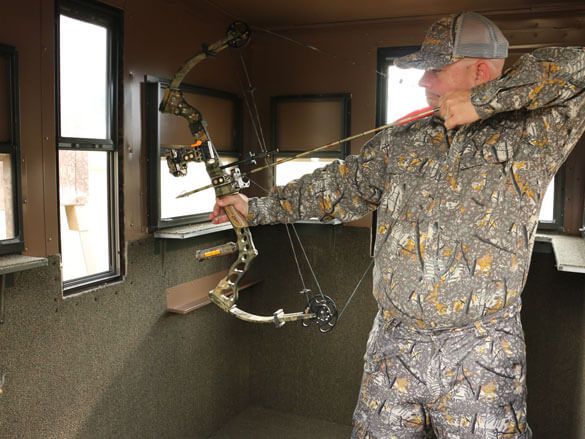
Before hunting, sit inside the blind with your bow.
Practice:
- Drawing
- Anchoring
- Rotating
- Positioning
- Looking through each shooting window
- Moving between windows
You should know whether your bow limbs, cams, strings or accessories can contact the blind.
For more information, read: How to Shoot a Bow From a Hunting Blind, and Best Bow Hunting Blind Window Setup.
Ground Blind Placement for Gun Hunting
Gun hunting also requires careful attention to shooting lanes and safe backstops.
When positioning a ground blind for gun hunting, consider:
- Legal shooting direction
- Safe backstop
- Property boundaries
- Neighboring properties
- Visibility
- Shooting distance
- Window configuration
- Terrain
- Deer approach
- Wind
- Access
Never assume that an open view automatically represents a safe shooting direction.
Know your property boundaries and applicable hunting regulations before hunting.
For broader guidance, read: Best Deer Blinds for Gun Hunting
Ground Blind Placement in Woods
Wooded properties offer natural concealment but can create other challenges.
In the woods, look for:
- Natural openings
- Timber edges
- Trails
- Small clearings
- Funnels
- Creek crossings
- Terrain transitions
- Thick cover
- Existing shooting lanes
Avoid unnecessarily cutting vegetation simply to create a shooting position.
Instead, work with the existing environment where practical.
Use Natural Backgrounds
A ground blind can be easier to conceal when surrounded by:
- Trees
- Brush
- Tall grass
- Fallen timber
- Natural shadows
The goal is to make the blind visually blend into the surrounding environment without obstructing safe shooting lanes.
Ground Blind Placement in Open Fields
Open fields can provide excellent visibility but may make blind concealment more difficult.
When hunting an open field, consider:
- Field edges
- Tall grass
- Brush lines
- Fence lines
- Terrain changes
- Existing vegetation
- Shadows
- Background cover
An exposed blind in the middle of a featureless field may be more noticeable than one positioned against an existing visual break.
If the property provides no natural concealment, carefully consider how the blind will look from the direction deer are approaching.
Ground Blind Placement on Field Edges
Field edges often combine:
- Food
- Cover
- Travel routes
- Visibility
This makes them important areas to investigate.
Look for locations where deer naturally transition between:
Cover → Edge → Food
or
Food → Edge → Cover
A blind positioned near this transition can potentially provide useful visibility while keeping the blind close to existing cover.
How to Position a Ground Blind for Concealment
A ground blind should not necessarily be hidden completely.
Instead, the goal is to minimize its visual impact.
Consider:
Background
Position the blind against vegetation, timber or terrain when practical.
Shadows
A blind sitting in bright sunlight may be more visually obvious than one that blends into surrounding shade.
Color and exterior
Choose a blind that fits the surrounding environment.
Vegetation
Natural vegetation can help break up the outline.
Distance
The farther away deer are from the blind, the less detailed the structure may appear, but distance must still allow practical hunting.
Movement
Even a well-hidden blind can become noticeable if the hunter moves excessively near an open window.
For more detail, read: How to Conceal a Ground Blind From Deer
Shooting Lanes and Shooting Angles
A blind location isn’t complete until you know where your safe shooting lanes will be.
Before finalizing the location, identify:
- Primary shooting lane
- Secondary shooting lanes
- Deer approach routes
- Potential shot distances
- Obstacles
- Property boundaries
- Safe backstops
- Window positions
Don’t Create Too Many Shooting Lanes
More visibility isn’t always better.
Clearing too much vegetation can make the blind more obvious and may alter the natural appearance of the area.
Instead, create only the lanes you actually need.
Blind Orientation and Window Placement
The direction your blind faces matters.
Consider orienting windows toward:
- Primary deer trails
- Food plots
- Fields
- Travel corridors
- Water
- Shooting lanes
But don’t sacrifice concealment and wind simply to point a window at a food source.
The best orientation balances:
Visibility + wind + concealment + access + safe shooting
Think About the Sun
Direct sunlight can affect visibility through windows.
Depending on the hunting time, you may want to avoid having the sun directly in your eyes when looking toward a primary shooting area.
Sun position also changes throughout the year.
Ground Blind Height and Visibility
Most ground blinds sit at ground level, but their exact placement can still affect your visual perspective.
A blind placed:
- In a depression
- Behind a small rise
- Along a slope
- Near tall vegetation
may have a different visibility profile than one sitting on completely exposed flat ground.
Use the terrain to your advantage.
However, don’t position a blind in a location that creates water drainage problems, unstable footing, or unsafe shooting conditions.
Ground Blind Placement for Multiple Hunters
If two or more hunters will use the same ground blind, placement becomes more complicated.
Consider:
- Blind dimensions
- Number of windows
- Shooting directions
- Bow clearance
- Gear storage
- Seating
- Movement
- Communication
- Noise
A blind that works well for one hunter may feel restrictive with two hunters.
Before placing it, simulate how both hunters will sit and which windows they will use.
Permanent vs. Portable Ground Blind Placement
Your placement strategy may also depend on the type of blind.
Permanent Ground Blind
A permanent or semi-permanent ground blind can justify more careful long-term planning.
Consider:
- Long-term deer movement
- Weather exposure
- Drainage
- Maintenance
- Accessibility
- Concealment
- Property management
Portable Ground Blind
A portable blind provides greater flexibility.
This can be useful when:
- Deer patterns change
- Food sources change
- Seasonal movement changes
- You need to adjust for wind
- You’re hunting different areas
However, portability does not eliminate the need for careful placement.
A portable blind still needs to be positioned with wind, concealment, access and shooting lanes in mind.
Common Ground Blind Placement Mistakes
Understanding what not to do can save you time and prevent unnecessary disturbance.
1. Putting the blind directly on a deer trail
A deer trail is useful because animals use it, but that doesn’t mean the blind belongs directly on the trail.
2. Ignoring the wind
A perfect-looking location can become problematic if your scent consistently moves toward deer.
3. Placing the blind too close to bedding cover
This can increase the chance of disturbing deer.
4. Ignoring access
If you have to walk through the main hunting area to reach the blind, the location may be counterproductive.
5. Clearing too much vegetation
Excessive clearing can make the blind stand out and alter the area.
6. Creating unsafe shooting lanes
Never sacrifice safety for visibility.
7. Choosing a location based only on deer tracks
One sign does not tell the entire story.
Look for multiple indicators of movement.
8. Ignoring thermals
Terrain and temperature can influence scent movement.
9. Setting the blind where water collects
Poor drainage can create muddy, wet or unstable conditions.
10. Changing the blind location constantly
Constantly moving a blind can create unnecessary disturbance.
Study the property and make deliberate changes based on evidence.
Step-by-Step Ground Blind Placement Process
Use this process when setting up a new ground deer blind.
Step 1: Map the property
Identify:
- Food
- Water
- Bedding
- Cover
- Trails
- Terrain
- Access
Step 2: Scout deer movement
Look for physical sign and camera information.
Step 3: Identify likely travel corridors
Determine where deer move between bedding, food and cover.
Step 4: Study wind
Identify the expected wind direction during your hunting period.
Step 5: Analyze thermals
Consider slopes, valleys and temperature changes.
Step 6: Plan access
Choose an entry route that minimizes disturbance.
Step 7: Select the blind location
Balance:
- Deer movement
- Wind
- Concealment
- Access
- Shooting lanes
Step 8: Determine window orientation
Point your primary windows toward useful shooting areas.
Step 9: Check shooting distances
Make sure the location works for your hunting method.
Step 10: Check safety
Confirm:
- Safe shooting directions
- Backstops
- Property boundaries
- Stable ground
- Legal requirements
Step 11: Conceal the blind
Use the surrounding environment without unnecessarily disturbing the property.
Step 12: Test the setup
Sit inside the blind before hunting.
Check every window, shooting position and access route.
Ground Blind Placement Scenarios
Scenario 1: Small Wooded Property
Suppose you have a small property with:
- Thick timber
- A food plot
- Several deer trails
- Bedding cover
Instead of placing the blind directly beside the bedding area, identify the route deer use between bedding and the food plot.
Then determine which side gives you the best wind and access.
Your final location may be along the travel corridor rather than directly at the food plot.
Scenario 2: Large Agricultural Field
Imagine a large open field surrounded by timber.
The blind may be difficult to conceal in the center.
Instead, investigate:
- Field corners
- Timber edges
- Brush lines
- Travel corridors
- Fence crossings
The objective is to maintain visibility without creating an obvious structure in an otherwise open landscape.
Scenario 3: Food Plot With Multiple Entry Trails
If deer approach a food plot from three different directions, don’t automatically select the side with the most tracks.
Study:
- Wind
- Bedding
- Cover
- Access
- Time of movement
The best location may be along one of the approach routes rather than directly overlooking the center of the plot.
Scenario 4: Bowhunting From a Ground Blind
A bowhunter may need closer and more carefully controlled shooting opportunities.
The placement should provide:
- Suitable shooting distance
- Adequate bow clearance
- Proper window height
- Concealment
- Minimal movement
- Favorable wind
- Safe access
Practice the complete shot process from inside the blind before hunting.
Ground Blind Placement Checklist
Before finalizing your blind location, ask:
Deer Movement
-
Where are deer bedding?
-
Where are they feeding?
-
Where are they traveling?
-
Are there funnels?
-
Are there predictable crossings?
Wind
-
What is the expected wind direction?
-
Where will my scent travel?
-
Could terrain change the wind?
-
Have I considered thermals?
Access
-
Where will I park?
-
What route will I walk?
-
Will I cross deer trails?
-
Can I leave without disturbing deer?
Concealment
-
Does the blind blend into the background?
-
Is natural vegetation available?
-
Is the blind exposed?
-
Have I considered sunlight and shadows?
Shooting
-
Are shooting lanes clear?
-
Are shooting angles appropriate?
-
Are distances appropriate?
-
Are shooting directions safe?
-
Are property boundaries known?
Blind Setup
-
Is the ground stable?
-
Is drainage adequate?
-
Are windows positioned correctly?
-
Can I comfortably shoot from inside?
-
Is there enough room for my equipment?
FAQs: Ground Blind Placement
Where is the best place to put a ground blind for deer hunting?
How far should a ground blind be from a deer trail?
Should I put a ground blind near a bedding area?
Should a ground blind face the food plot?
How long should a ground blind sit before hunting?
Is it better to place a ground blind in the woods or field?
How do I keep deer from seeing my ground blind?
Can I move my ground blind during hunting season?
Final Thoughts on Ground Blind Placement
Good ground blind placement starts with understanding the property rather than simply finding a place where a blind fits.
Study deer movement. Identify bedding and feeding areas. Follow travel corridors. Pay attention to wind and thermals. Plan your entry and exit route. Use terrain and natural vegetation for concealment. Build practical shooting lanes and orient the blind around the way you actually hunt.
For bowhunting, pay particular attention to shooting distance, window height, bow clearance and movement inside the blind. For gun hunting, carefully evaluate visibility, shooting lanes, safe shooting directions and property boundaries.
Most importantly, avoid treating one factor as the entire answer. The strongest ground blind setups combine deer movement + wind + concealment + access + shooting opportunities + safety.
When you’re ready to choose a blind for your property, explore Hunting Blind Supply’s selection of ground hunting blinds, deer hunting blinds, bow hunting blinds, gun hunting blinds, insulated blinds and elevated hunting solutions.
Hunting Blind Supply is presented by the business as the “#1 trusted seller” for deer hunting blinds. The company is family-owned in Texas and has been manufacturing hunting blinds since 2020.
Shop Ground Hunting Blinds and build your setup around the property, the deer and the way you hunt.